Waterloo Epoxy Flooring applies polyaspartic floor coatings in Waterloo, IA, serving surrounding cities including Evansdale, Cedar Falls, Waverly, Independence, Oelwein. In more than 20 years of coating concrete, polyaspartic has become one of the materials we reach for most often, especially as a topcoat on garage floors that have to face salt, sunlight and hot tires.
Polyaspartic is a type of aliphatic polyurea that cures quickly, stays clear under ultraviolet light and resists abrasion and chemicals well. Those properties make it a strong wear layer, but they also make it unforgiving: it sets fast, so the slab preparation and the installer’s timing have to be right the first time.
That is why we treat polyaspartic as part of a system rather than a miracle product. Every slab is ground, tested for moisture and repaired before the first coat, and the proposal names the product line, the number of coats and the finished thickness, so you know exactly what is on your floor.
What Polyaspartic Coatings Do Well
Fast Cure and Quicker Return to Service
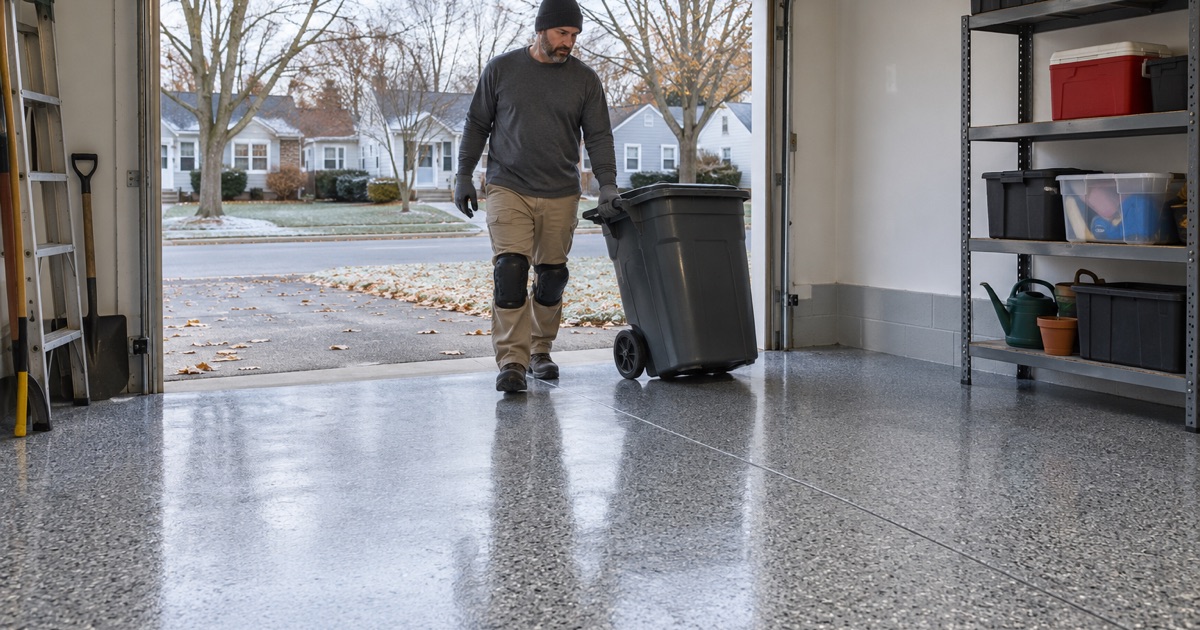
Polyaspartic cures in hours rather than days. On the right garage, grinding, repairs, base coat, flake and topcoat can be completed in one working day, and the floor can take foot traffic soon after, with vehicles following once the topcoat has cured to the manufacturer’s schedule.
That speed matters to homeowners who do not want their car out in the driveway all week, and even more to businesses that need a floor back in use overnight. The trade-off is a short working time, which is why experience with the product matters.
UV Stability and No Ambering
Epoxy tends to amber, or yellow, when exposed to sunlight over time. Aliphatic polyaspartic coatings are UV-stable, so a topcoat of polyaspartic keeps a light flake blend or a clear finish looking the way it did on day one, even near an open overhead door.
This is one of the main reasons we put a polyaspartic topcoat over an epoxy base. The epoxy builds the thickness and the bond; the polyaspartic protects the color.
Abrasion, Chemical and Hot Tire Resistance
Polyaspartic topcoats resist abrasion from grit and tires, and they hold up to many automotive fluids and to salt brine. They also resist hot tire pickup, where a warm tire softens a weak coating and lifts it, which is the most common failure in thin retail garage coatings.
No topcoat is immune to everything, however. Some strong solvents and acids can still damage it, so in shops and plants we check the actual chemicals against the manufacturer’s resistance data before choosing the system.
How We Install a Polyaspartic Floor
Grinding for a Real Profile
Polyaspartic penetrates and bonds well, but only to clean, open concrete. We grind every slab with diamond tooling or shot blast it to the concrete surface profile the system calls for, with dust captured at the machine rather than swept or rinsed toward a drain.
Acid etching does not give a consistent enough profile for a fast-curing coating. A floor that has been etched instead of ground is far more likely to delaminate, and the speed of polyaspartic makes that failure appear faster.
Moisture Testing Before We Commit
Polyaspartic will not tolerate excessive moisture vapor coming up through a slab any better than epoxy will. We use ASTM F2170 relative humidity probes or ASTM F1869 calcium chloride tests and compare the result with the manufacturer’s limit before we finalize the price.
When a reading is high, a moisture-mitigation primer can go down first, within that primer’s rated limits. When it is too high for any system we would stand behind, we tell you before any money changes hands.
Temperature, Dew Point and Working Time
Polyaspartic can cure at lower temperatures than many epoxies, which extends the coating season in heated basements and partly heated garages. But the slab must still be above the product’s minimum temperature and safely above the dew point, or moisture can condense on the surface and weaken the bond.
We measure slab temperature and the dew point spread on the day of the job. In an unheated garage during a northeast Iowa cold snap, we will reschedule rather than push a fast-curing coating onto a cold, damp slab.
Coats, Broadcast and Finished Thickness
A typical polyaspartic garage system includes a base coat, a full vinyl flake or quartz broadcast, and one or two clear polyaspartic topcoats. The number of coats and the finished thickness are listed in the proposal, so the floor can be checked against what was quoted.
Where a floor needs more build, such as over a rough or heavily patched slab, we use a thicker 100% solids epoxy base under the polyaspartic topcoat. That combination fills imperfections that a thin, fast coat would simply follow.
Residential Polyaspartic Coatings
Garage Floors Through Iowa Winters
Garage floors here carry brine and rock salt in on tires from November through March. A polyaspartic topcoat keeps that salty water on the surface, where it can be squeegeed out, instead of letting it soak into concrete that then scales through freeze-thaw cycles.
We also look at the slab near the overhead door, where melting snow sits longest. That area is often the most pitted, and it gets extra repair work before any coating goes down.
Basements and Attached Garages
In a basement or attached garage, odor during installation is a real comfort question. We offer lower-odor products for these spaces as a re-entry choice rather than a legal requirement, since Iowa has no state VOC rule for floor coatings and the federal limit binds manufacturers instead.
Basements also get a closer look at moisture. We check the sump pit, the floor drain and the slab for signs of past water first, because a polyaspartic coating does not stop seepage and is not waterproofing.
Commercial Polyaspartic Coatings
Floors That Must Reopen Quickly
For stores, offices, clinics and service bays, the speed of polyaspartic is often the deciding factor. A section can be ground, coated and returned to service in a single overnight or weekend window, limiting the time a business has to close part of its floor.
We phase larger floors so work moves through the building in zones, coordinated with your schedule in writing before we start. That way staff and customers know which areas are open each day.
Auto Service, Fleet and Equipment Bays
Service bays see brake fluid, oil, solvents, salt and rolling jacks. A polyaspartic topcoat over a solid base gives these floors abrasion and chemical resistance, and a light texture keeps them safe when wet or oily.
For bays with heavy steel equipment or frequent dropped parts, we build more thickness into the system. A thin coat alone can chip under a dropped transmission or a jack stand.
Light Color and Clean Appearance
Showrooms and customer-facing spaces want a floor that looks bright and stays that way. Because polyaspartic resists ambering, light gray and white flake systems keep their color, which matters in spaces with large windows or doors open through the warmer months.
A clear polyaspartic topcoat also cleans up easily with an auto-scrubber or a mop and a neutral cleaner. In a dealership or a clinic lobby that is mopped every night, that ease of cleaning is worth as much as the initial look.
What a Polyaspartic Warranty Leaves Out
Moisture Is the First Exclusion
Almost every coating warranty, whatever the product, excludes failures caused by moisture vapor transmission and hydrostatic pressure from below the slab. We name that exclusion before the job is sold and explain how the moisture test connects to it, so the warranty is understood rather than discovered.
Other common exclusions include damage from chemicals outside the product’s resistance, gouges from dragged steel and failures caused by movement in the slab itself. We walk through those in plain language with the proposal, alongside what the warranty does cover.
- 20+ Years Coating Concrete
- Moisture Test in Every Scope
- Free Written Estimates