Waterloo Epoxy Flooring has installed epoxy garage floors in Waterloo, IA for more than 20 years, serving surrounding cities including Evansdale, Cedar Falls, Waverly, Independence, Oelwein. A garage floor here has a hard job: it carries salt brine in from the street half the year, sits through dozens of freezing nights, and has to hold a hot tire without letting go.
We build garage floors to handle that, and the work starts below the coating. Each slab is ground with diamond tooling, tested for moisture, and checked for cracks and old finishes before we write a price, because those three things decide whether a garage coating lasts one season or many.
Your proposal lists the product line, how many coats go down, and the finished thickness. When the floor is done, you can hold it up against that paper and check that you got what you paid for.
What Goes Into a Professional Garage Floor
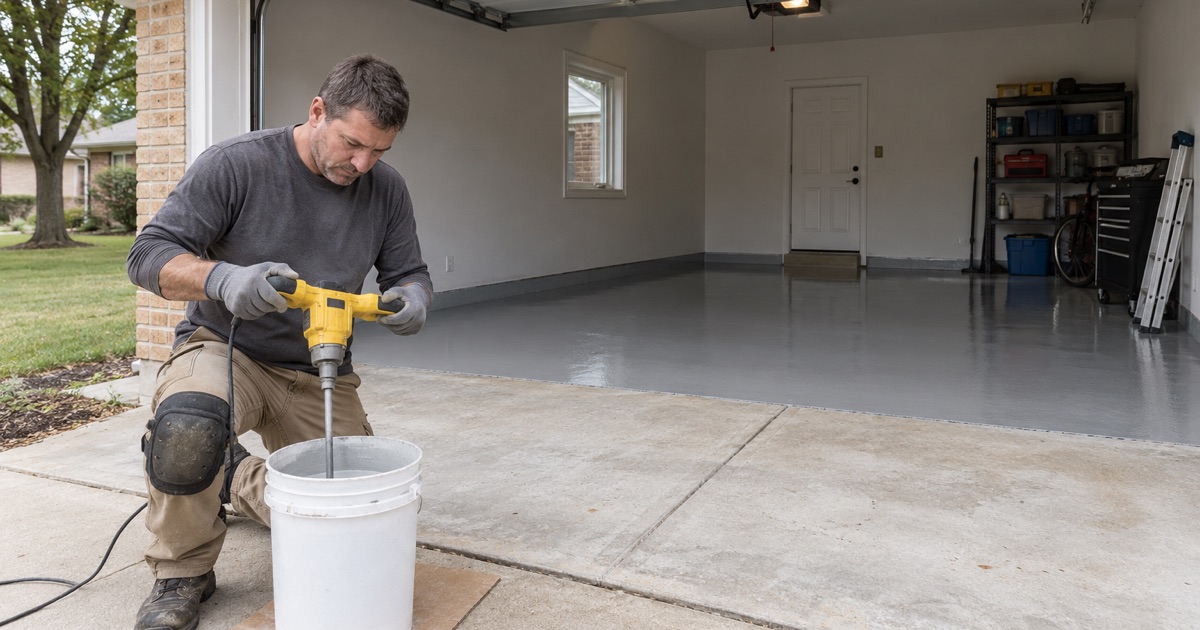
Diamond Grinding the Garage Slab
An untouched garage slab has a smooth top layer of cement paste, often with oil stains, tire marks and sealer on it. We grind that layer away with diamond tooling to open a concrete surface profile the epoxy can lock into, and the grinder’s vacuum pulls the dust off at the machine.
Acid etching is the shortcut many kits rely on, and it leaves an uneven surface and residue behind. Grinding gives a consistent profile across the whole floor, which is why it is the only preparation we use on a garage.
Repairing Cracks, Spalls and Pitting
Garage slabs pick up shrinkage cracks, chipped control joints and pitted patches near the door where salt water sits. We route and fill cracks, rebuild spalled edges and patch pitting with a rigid repair material, then grind every repair flush so it does not telegraph through the finish.
Not every slab is worth saving. When a floor has heaved, settled unevenly or broken into loose pieces, we tell you that a coating would only hide the problem, and we recommend replacing that section first.
Base Coat, Flake Broadcast and Topcoat
Most of our garage systems start with a 100% solids epoxy base coat, which builds thickness and bonds hard to ground concrete. While it is still wet, vinyl flake is broadcast across the floor, then scraped and sealed under a clear polyaspartic or polyurea topcoat.
That combination gives you a thick, bonded base and a tough, UV-stable wear surface. It also allows a quicker return to service than an all-epoxy system, since the topcoat cures faster.
Testing the Garage Slab Before We Price It
Why Many Garages Have No Vapor Retarder
The model residential code, IRC R506.2.3, calls for a vapor retarder under slabs in living space but exempts garages and other unheated accessory buildings. In practice that means a garage slab can sit directly on soil with nothing to slow ground moisture rising through it.
Moisture moving up through concrete is one of the most common reasons a garage coating blisters or peels. That is why a moisture test is written into every garage scope before the price is final.
The Moisture Tests We Use
We use ASTM F2170 in-situ relative humidity probes, which read conditions inside the slab, or ASTM F1869 calcium chloride tests, which measure the vapor emission rate at the surface. An ASTM D4263 plastic sheet test is a quick screen, not a final answer.
The reading is compared with the coating manufacturer’s limit. If it sits above that limit, a moisture-mitigation primer or a different system goes into the scope, and the result is recorded on your proposal.
A Newer House Is Not a Drier Garage
It is easy to assume a garage poured a few years ago will be dry and one from the 1950s will be damp. The code exemption, the soil under the slab and drainage around the house matter far more than the build year, so we test every garage regardless of age.
A newer slab also brings its own question: concrete needs time to give up the water it was poured with. A recently poured garage floor may simply not be ready yet, and the test result tells us whether to coat now or come back after the slab has had longer to dry.
Built for Northeast Iowa Winters
Salt Brine and Rock Salt on Tires
From November through March, every car pulling into a garage carries brine and rock salt off the street. On bare concrete that salty water soaks in, and when it freezes and thaws the surface starts to scale and pit. We pick garage systems with a chemical-resistant topcoat so the brine sits on top where it can be squeegeed out.
The area just inside the overhead door takes the worst of it, because that is where snow melts off the car first. We pay extra attention to the slab there during preparation, since it is often the most pitted and the most contaminated part of the floor, and a weak spot at the door is where a coating starts to fail.
Freeze-Thaw Scaling on Garage Slabs
Scaling is the flaking of the top layer of concrete after repeated freeze-thaw cycles with water and deicer in the surface. A garage slab that is already scaling has to be ground back to sound concrete and patched before coating, and we price that repair as its own line so it is never a surprise.
Coating a Garage When It Is Cold
Epoxy and polyaspartic coatings each have a minimum slab temperature, and the slab also needs a safe dew point spread so moisture does not condense on the surface. A cold, humid floor can produce amine blush, a waxy film that weakens the bond between coats.
We watch the slab temperature and dew point rather than the calendar. In an unheated garage in the middle of a northeast Iowa winter, we will tell you to wait for warmer weather rather than coat a floor that cannot cure properly.
Choosing Your Garage Floor System
Flake Blends and Chip Size
Flake blends range from tight speckled patterns to bold, larger chips with high contrast. A full broadcast, where the floor is covered completely in flake, hides dust and small blemishes best and adds light texture underfoot, which helps on a floor that sees melting snow.
A partial broadcast, with flake scattered more lightly over a solid base color, gives a cleaner, more modern look and costs a little less in material. It shows dust and tire marks more readily, though, so we bring sample boards to the garage and let you see both under your own lighting before you choose.
Topcoats and Hot Tire Pickup
Hot tire pickup happens when a warm tire softens a thin coating and lifts it as the car cools and pulls away. A ground slab, a thick bonded base and a polyaspartic or polyurea topcoat are the defenses against it, and they are standard on the garage systems we install.
Topcoat choice also affects how the floor looks after a few years of sunlight through an open door. Epoxy left exposed to ultraviolet light tends to amber, while polyaspartic and polyurea topcoats stay clear, which matters most on light flake blends and in garages that face south.
Retail Kits Compared With a Built-Up Floor
A retail kit is usually a thin, water-based coating rolled over an etched slab, and it can look good for a while. A professional garage floor is ground, repaired and built to a stated thickness with a real topcoat, which is what lets it handle tires, salt and dropped tools for years.
We get calls every spring about kit floors that have lifted in patches under the tires or around the door. Removing a failed kit means grinding it all off before a real system can go down, so the cheapest floor in the first year often becomes the most expensive one by the third.
Odor in Attached Garages
An attached garage shares air with the house, so coating odor can drift inside while the floor cures. We offer low-odor products as a comfort choice and seal the house door during the work; Iowa has no rule requiring them, and we do not pretend otherwise.
- 20+ Years Coating Concrete
- Moisture Test in Every Scope
- Free Written Estimates