Waterloo Epoxy Flooring installs commercial epoxy flooring in Waterloo, IA, serving surrounding cities including Evansdale, Cedar Falls, Waverly, Independence, Oelwein. With 20+ years of concrete coating behind us, we plan commercial floors around two things at once: the conditions the floor has to survive and the hours your business cannot stop.
Commercial floors range from quiet office corridors to auto service bays that see brake fluid and rolling jacks every day. One system does not suit all of them, so we start by asking how the floor is used, cleaned and seen, then specify a system to match. Every slab is ground or shot blasted, tested for moisture and repaired before coating.
The proposal names the product line, the number of coats and the finished thickness, which gives your facilities team something concrete to check against when the work is done. It also lays out the phasing plan, so everyone knows which areas close when.
Matching the System to the Space
Retail Stores and Showrooms
Retail floors need to look good and handle constant foot traffic, carts and the grit customers carry in from the parking lot. Flake epoxy, metallic epoxy and solid colors with a polyaspartic or polyurethane topcoat give a durable, easy-to-clean surface that still fits a brand.
Gloss level is a practical choice here, not only a style one. A high gloss looks striking but shows scratches and dust faster, while a satin finish hides daily wear better in a busy store.
Offices, Clinics and Lobbies
Offices and clinics want a seamless floor that cleans quickly and looks finished. A coated floor has no grout lines or carpet seams to trap dirt, and it handles rolling chairs and carts without wearing paths.
In clinics and lobbies, we pay particular attention to cleanability and traction near entrances, where snow and water are tracked in through the winter months. A slightly textured topcoat near the doors and a smoother finish deeper inside often gives the best balance.
Auto Repair, Fleet and Service Bays
Service bays face oil, brake fluid, coolant, solvents, road salt and heavy rolling equipment. For these floors we build a thicker system with a chemical-resistant topcoat and a light texture for grip when the floor is wet or oily.
We review the fluids your shop actually uses against the coating manufacturer’s chemical resistance data. A topcoat that holds up to motor oil may not hold up to a specific parts cleaner, and it is better to know that before the floor goes down.
Restaurants and Food Service
Front-of-house dining areas can use a decorative epoxy system, but kitchens and wet prep areas need a different approach. There, we typically recommend a urethane cement system with coved bases, specified to the FDA Food Code that Iowa adopts and inspected locally by the Black Hawk County Health Department.
The transition between a decorative dining floor and a kitchen system needs planning, too. We set the change at a doorway or a clean line, keep the two systems at the same height so carts roll across without a lip, and seal the joint between them.
Preparation and Testing
Grinding and Shot Blasting
Every commercial slab is opened with diamond grinding or shot blasting to the concrete surface profile the system calls for. Acid etching does not give a consistent enough profile for a commercial floor, and we never use it.
Dust is captured at the machine by an industrial vacuum, and grinding slurry is never rinsed toward floor drains or storm inlets. In occupied buildings we also seal off work zones and protect HVAC returns.
Moisture Testing
Commercial slabs are tested with ASTM F2170 relative humidity probes or ASTM F1869 calcium chloride tests before the system is finalized. Where a reading exceeds the coating manufacturer’s limit, a moisture-mitigation primer is written into the scope as its own line.
Moisture is also the first exclusion we name when we discuss the warranty. Failures caused by moisture vapor transmission and hydrostatic pressure are excluded from almost every coating warranty, and we explain that before the job is sold.
Repairs, Joints and Old Coatings
Cracks, spalls and failing joints are mapped and repaired before coating, and old coatings are removed down to sound concrete. Joints in high-traffic areas get a semi-rigid filler that supports their edges against carts and forklifts.
Scheduling Around Your Business
Phasing the Work
We divide larger floors into zones and complete them one at a time, so most of your building stays usable. The sequence is planned with your manager and written into the proposal, including which areas are closed each day.
Faster-curing systems such as polyaspartic topcoats can shorten the time each zone is out of service, sometimes allowing a section to reopen the next morning. Heavier systems take longer, and we plan the zones around that rather than rushing a cure.
Night and Weekend Installation
When a store, clinic or office cannot close during the day, we work overnight or over weekends. Grinding is noisy, so we confirm working hours with building management and neighbors before scheduling it.
Odor and Occupied Buildings
Some coatings have a strong odor during application. We offer low-odor products for occupied buildings as a comfort choice and plan ventilation with your team. Iowa has no state VOC rule for floor coatings; the federal 40 CFR 59 Subpart D limit applies to manufacturers.
Safety, Texture and Upkeep
Slip Resistance by Specification
Traction comes from the materials, not from a promise. We specify it through a quartz or flake broadcast and the topcoat used, or a grit additive in the final coat, and we match the texture to how the floor will be cleaned.
More texture is not always better. A very coarse floor is harder to mop and can hold dirt, so in a clinic corridor we may keep a fine grit, while a car wash bay or a back door that takes snow all winter gets a coarser quartz broadcast. We show you samples of each texture before the system is set.
Safety Lines and Markings
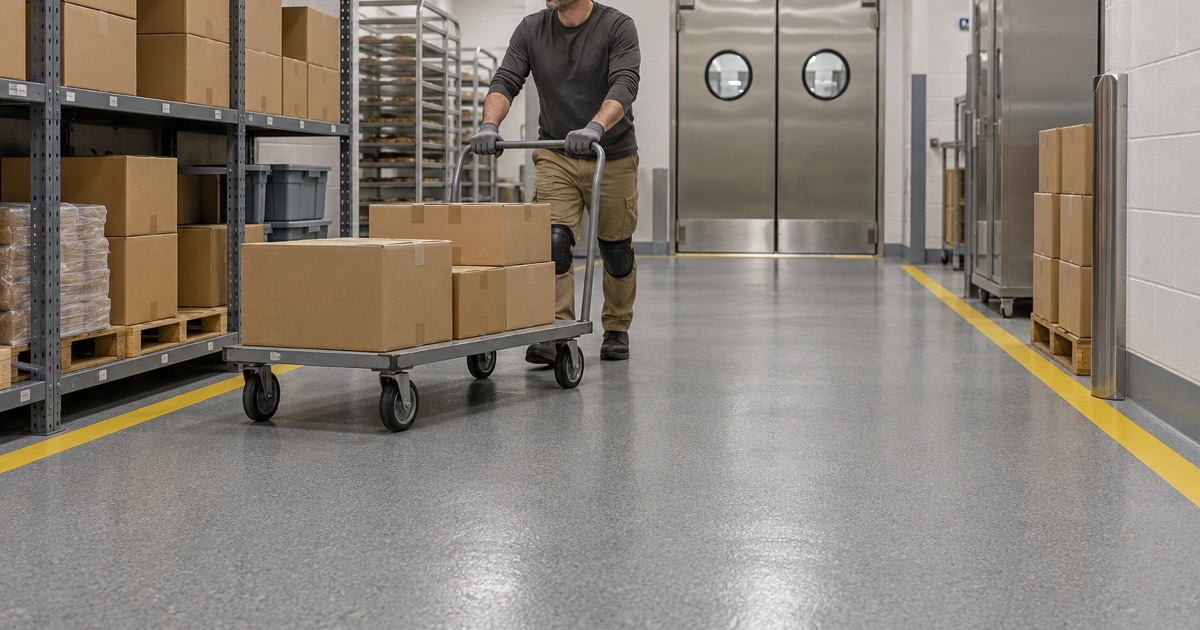
Warehouses, shops and service areas often need aisle lines, walkways and equipment zones marked on the floor. We can coat those markings into the system so they wear with the floor rather than peeling like tape or paint.
Cleaning and Maintenance
We leave written maintenance guidance with every commercial floor: which cleaners to use, which to avoid, and how often. A neutral cleaner and regular dust mopping keep the floor looking new far longer than harsh degreasers that dull the topcoat.
- 20+ Years Coating Concrete
- Moisture Test in Every Scope
- Free Written Estimates