Waterloo Epoxy Flooring installs industrial epoxy flooring in Waterloo, IA, serving surrounding cities including Evansdale, Cedar Falls, Waverly, Independence, Oelwein. In more than 20 years of grinding and coating concrete, we have learned that an industrial floor fails for predictable reasons: the wrong system for the chemicals, too thin a build for the traffic, or a slab that was never properly prepared.
Waterloo is a manufacturing city, home to tractor, engine and foundry operations, meat processing and cabinet production. Those plants show what industrial floors here are up against, from hydraulic fluid and coolant to hot washdown water and steel parts dropped from a bench. None of them is a customer of ours; they simply define the conditions we design for.
We start every industrial job by understanding the floor’s exposure and the production schedule. The proposal then names the product line, each coat, the finished thickness and the phasing plan, so your operations and maintenance teams know what is being installed and when.
Designing for Industrial Conditions
Chemicals and Fluids
Oils, coolants, hydraulic fluid, fuels, solvents and cleaning chemicals all affect a floor coating differently. We review the safety data sheets for the fluids that actually reach the floor against the coating manufacturer’s chemical resistance chart before choosing a system.
Where a standard epoxy will not hold up, we move to a chemical-resistant topcoat, a novolac epoxy or a urethane cement. Getting that choice right is the difference between a floor that lasts years and one that softens or stains in months.
Forklifts, Impact and Abrasion
Forklifts, pallet jacks and dropped parts put heavy point loads and impact on a floor. Thin coatings chip and wear through quickly under that traffic, so busy aisles and loading areas get a thicker build, often a broadcast or troweled system with quartz aggregate for strength.
Joints matter as much as the coating. Forklift wheels break down unsupported joint edges, so we rebuild damaged edges and fill joints with a semi-rigid filler before coating.
Heat, Hot Water and Washdown
Floors exposed to hot water, steam cleaning or heat from ovens and processes need a system that tolerates thermal shock. Urethane cement is our usual choice for these areas, because standard epoxy can soften, crack or lose its bond under repeated temperature swings.
Washdown floors also need correct slope to drains and coved bases at the walls. We plan those details into the system rather than leaving water to pool along the edges.
Systems We Install
Thick-Build and Broadcast Epoxy
For general manufacturing and warehouse floors, a 100% solids epoxy built up in layers, often with a quartz or sand broadcast, gives a tough, impact-resistant surface. The broadcast adds strength and controlled texture for grip.
The number of broadcast layers and the finished thickness depend on the traffic in each area. A parts storage room might get one broadcast, while a main forklift aisle gets two or more, and the proposal lists each area’s build separately so nothing is averaged out.
Troweled Epoxy Mortar
Where impact and heavy loads are severe, a troweled epoxy mortar several times thicker than a standard coating can rebuild and protect the floor at once. It is common in heavy production areas and around equipment bases.
Mortar systems are also useful where a worn floor has lost its surface and become uneven. Instead of a separate resurfacing step, the mortar fills and protects in one installation, and a sealing coat on top makes it easier to clean.
Urethane Cement
Urethane cement handles hot water, steam, thermal shock and many aggressive chemicals. It is the standard for food processing and washdown areas, and it can be installed with coved bases and a textured finish for wet floors.
It is also more tolerant of damp concrete than many epoxies, which can matter in older plants where slabs have no vapor retarder. We still test the slab and follow the manufacturer’s limits, but urethane cement often gives more room to work in those conditions.
Chemical-Resistant Topcoats
Novolac epoxies and specialized polyurethane topcoats resist acids and solvents that would damage a standard epoxy. They are often used in battery rooms, chemical storage areas and containment zones.
Preparation, Testing and Repairs
Shot Blasting and Grinding
Industrial slabs are typically shot blasted on open areas and ground along edges and around equipment, giving a uniform concrete surface profile for thick systems. Dust is captured at the machine, and slurry or dust is never washed toward floor drains or storm inlets.
Oil-Soaked Concrete
Plant floors often carry years of oil absorbed deep into the concrete. Grinding removes surface contamination, but saturated areas may need degreasing, heat cleaning or a specialized primer so oil does not bleed back and break the bond.
We do small adhesion tests on suspect areas before committing to a system. If oil keeps rising through the profiled concrete, that section may need to be cut out and replaced, and we would rather find that out on a test patch than after the floor is coated.
Moisture Testing
We test industrial slabs with ASTM F2170 relative humidity probes or ASTM F1869 calcium chloride tests before finalizing the system. Where readings exceed the manufacturer’s limit, a moisture-mitigation primer is added to the scope, and we explain that moisture is the first warranty exclusion.
Installing Around Production
Phasing by Shift and Zone
We divide the floor into zones and complete them one at a time, planned with your operations team around production schedules. Overnight and weekend windows are used when a line cannot stop.
Each zone is barricaded and signed while it is being prepared and cured, and we coordinate with your safety staff on forklift routes and emergency exits. When a zone reopens, the next one closes, so the plant keeps a predictable path through the work.
Faster Return to Service
Faster-curing systems can shorten downtime in each zone, sometimes returning an area to service in a single shift. Where a heavier system needs longer, we plan the schedule so equipment and traffic are rerouted rather than rushing the cure.
Safety Markings and Handover
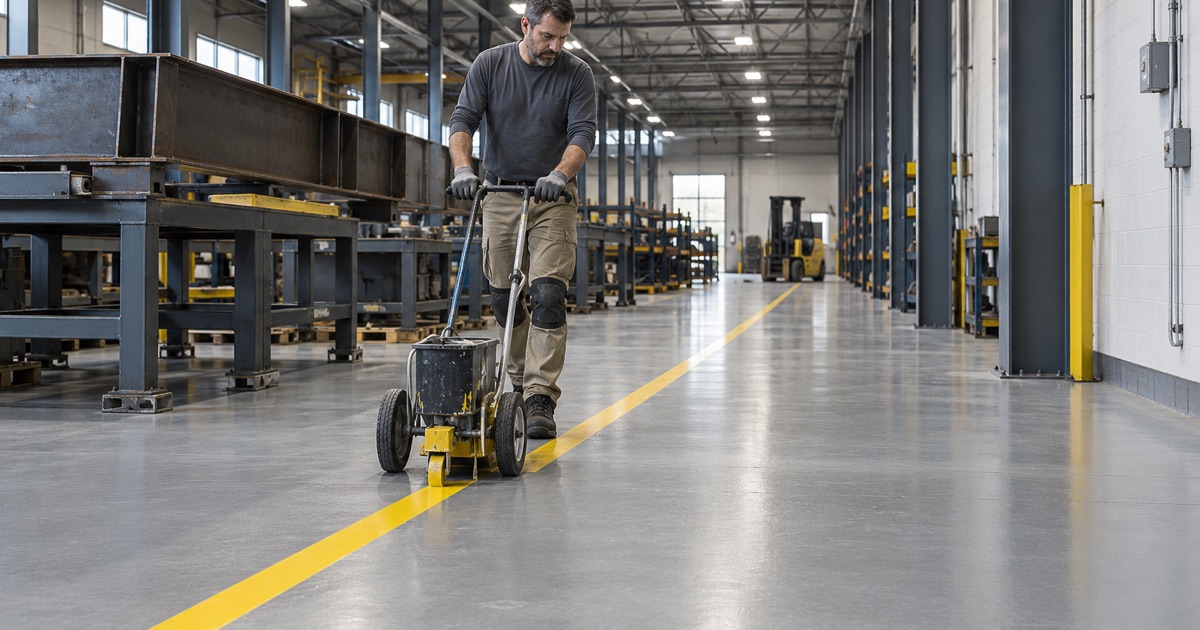
Aisle lines, walkways and equipment zones are coated into the system. At handover we provide product data and maintenance guidance so your team can clean and care for the floor without damaging the topcoat.
- 20+ Years Coating Concrete
- Moisture Test in Every Scope
- Free Written Estimates