
Waterloo Epoxy Flooring installs basement floor epoxy in Waterloo, IA, serving surrounding cities including Evansdale, Cedar Falls, Waverly, Independence, Oelwein. Over 20+ years we have coated a lot of basement floors, and the ones that last all have something in common: somebody answered the moisture question before the first coat went down.
A basement slab sits in the ground, often with no vapor retarder under it in older houses, and it can carry decades of paint, patches and tile glue. A coating that ignores either of those facts tends to blister or peel within a year or two. So our basement work starts with reading the floor: where water has been, how much vapor is moving through the slab, and what is already stuck to it.
Only then do we talk about color and finish. The proposal spells out the test result, the preparation, the product line, the number of coats and the finished thickness, and it names what the coating will not do, beginning with waterproofing.
Reading the Basement Before We Coat It
Looking for Signs of Past Water
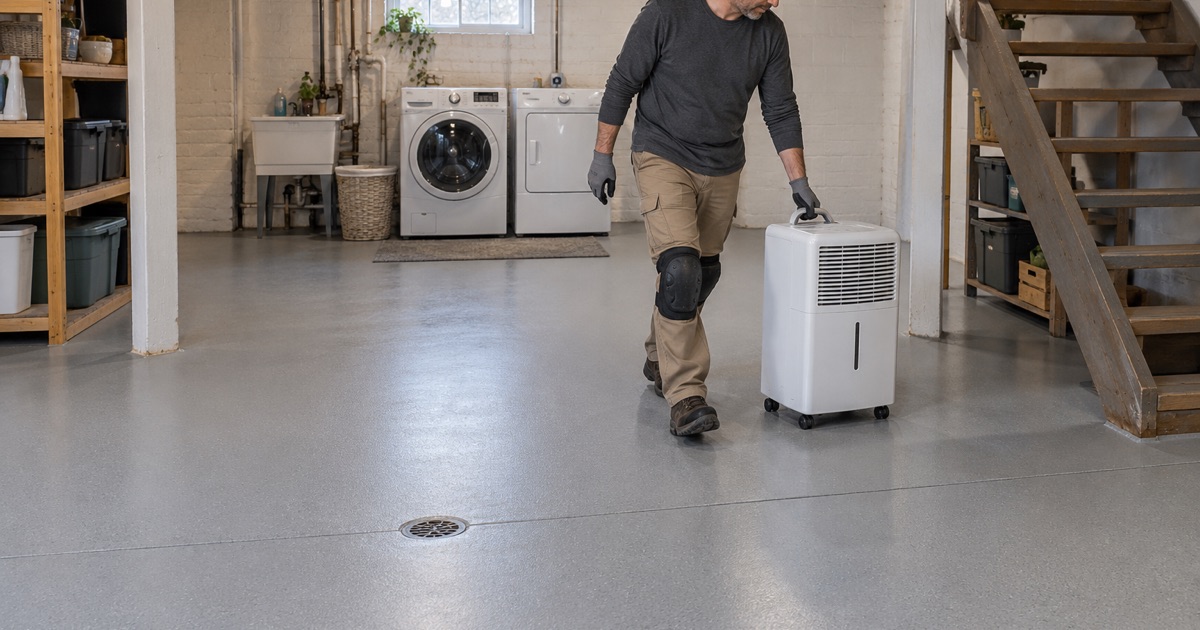
We start by walking the basement for evidence of water: staining along the walls, rust on appliance feet, tide lines on the slab, damp corners and the condition of the joint where the floor meets the wall. Those clues tell us whether the slab has a moisture problem or a water problem, which are not the same thing.
A moisture problem means vapor slowly moving up through the concrete. A water problem means liquid coming in, through cracks, the cove joint or the walls. A coating can sometimes handle the first with the right primer; it cannot fix the second.
Checking the Sump Pit and Floor Drain
The sump pit and floor drain tell us how water moves under and across the floor. We look at whether the sump runs often, whether the pit is dry or holding water, and whether the floor drain is clear and the slab slopes toward it.
Those features have to keep working after the floor is coated. We finish the coating cleanly at the pit rim and drain, keep the slope intact, and never seal over a drain tile cleanout or a sump lid that needs to come off.
Efflorescence and What It Means
White, powdery deposits on a basement floor are efflorescence: mineral salts carried to the surface by moisture moving through the concrete and left behind when it evaporates. They are a clear sign that water vapor is active in the slab.
Efflorescence does not automatically rule out a coating, but it means testing carefully and, in most cases, planning for a moisture-mitigation primer. Coating over it without addressing the moisture is a common reason basement floors fail.
Moisture Testing a Basement Slab
The Tests We Use
We measure basement slabs with ASTM F2170 in-situ relative humidity probes, which read moisture conditions inside the concrete, or ASTM F1869 calcium chloride tests, which measure how much vapor the surface is emitting. An ASTM D4263 plastic sheet test is a quick screen we use alongside them.
The result is compared against the coating manufacturer’s published limit. It goes on your proposal, so you can see the number that decided your system rather than taking our word for it.
When a Moisture-Mitigation Primer Is Needed
If the reading is above the coating’s limit but within the range a moisture-mitigation primer is rated for, the primer goes down first and the rest of the system is built on top of it. It is listed as its own line in the scope, since it adds material and time.
If the reading is beyond what any primer we would use can handle, we tell you so. Sometimes that means the drainage around the house needs attention first; sometimes it means a basement floor is better left uncoated.
Why Older Basements Often Test Higher
Nearly half of Waterloo’s homes were built before 1960, and many of their basement slabs were poured before an under-slab vapor retarder was common practice. Without that layer, ground moisture can move up through the slab more freely.
That does not mean every older basement is wet, or that a newer one is dry. It means the slab has to be tested rather than assumed, whatever year the house was built.
Preparing an Old Basement Floor
Paint, Sealer and Patching Layers
Many basement floors have been painted several times, sealed, patched and painted again. We grind those layers off with diamond tooling down to sound concrete, because a new coating can only grip as well as the weakest layer beneath it.
The grinder is connected to a vacuum that captures the dust at the machine. That keeps the rest of the house cleaner and keeps grinding debris out of the floor drain.
Tile, Mastic and Asbestos Caution
Older basements often have floor tile or the black adhesive left behind after tile was pulled up. Some older tiles and mastics contain asbestos, so we do not grind an unknown adhesive until it has been tested and, if needed, handled by a qualified abatement contractor.
Once the material is known to be safe or has been removed, we grind the floor clean and price the preparation accordingly. We flag this on the first visit so it never becomes a surprise halfway through the job.
Cracks and the Cove Joint
Shrinkage cracks are routed and filled before coating. We look closely at the joint where the floor meets the wall, since that is a common path for water, and we do not bury an active leak under a coating.
A crack that is moving or weeping water is noted in writing. It may need attention from a foundation or drainage contractor before the floor is coated.
Finishes, Uses and Limits
Laundry Rooms, Workshops and Gyms
A coated basement floor stands up well to washer spills, dropped tools and the weight of gym equipment. We choose the texture for each use: more grip in laundry rooms and near stairs, a smoother finish where carts roll or mats sit.
Flake broadcast systems hide dust and wear well, while a solid color or a metallic finish can make a finished basement feel like part of the living space. We bring sample boards down to the basement itself, since low ceilings and limited daylight change how a color reads.
Basements Near the Cedar River
The Cedar River reached a record crest of 27.01 feet at Waterloo on June 11, 2008, and some lower levels near the river have taken on water in past floods. A coated floor is easier to clean and dry after a wet event than carpet or bare painted concrete.
It is not flood protection, however, and it does not keep river water out. We are clear about that difference with every homeowner who asks.
Not Waterproofing, Not Radon Work
A basement floor coating is not waterproofing and does not hold back hydrostatic pressure. It is also not radon mitigation; in Iowa, radon testing and mitigation take a state credential, and we never sell a coating as either.
What the Warranty Will Not Cover
Coating warranties almost always exclude failures caused by moisture vapor transmission and hydrostatic pressure, and in a basement those are the likeliest causes of trouble. We explain those exclusions before the work is sold, alongside what the warranty does cover.
- 20+ Years Coating Concrete
- Moisture Test in Every Scope
- Free Written Estimates