
Waterloo Epoxy Flooring installs ESD flooring in Waterloo, IA, serving surrounding cities including Evansdale, Cedar Falls, Waverly, Independence, Oelwein. Electrostatic discharge can damage sensitive electronics, disrupt control systems and create hazards around flammable materials, and an ESD floor is one of the most effective ways to manage it. We bring more than 20 years of slab preparation and coating experience to these specialized systems.
An ESD floor is not just a coating with a different label. It is a layered system with a grounding network, conductive or dissipative layers and a finish engineered to fall within a specific electrical resistance range. If any part of that system is wrong, including the concrete preparation underneath, the floor will not perform as intended.
Our proposals name the product line, each layer, the finished thickness and the resistance range the floor is designed to meet. After installation we test the floor in place and hand over the readings, so your quality or facilities team can verify it against your specification.
Where ESD Floors Are Used
Electronics Assembly and Repair
Circuit boards and components can be damaged by static discharges far too small for a person to feel. Assembly lines, repair benches and test areas use ESD floors to give every person and cart a controlled path to ground, reducing the chance of hidden damage that shows up later as a failure in the field.
These areas usually follow a formal static control program. We design the floor to match the resistance requirements in that program and the footwear your workers use.
Server Rooms, Control Rooms and Labs
Server rooms, control rooms and laboratories hold expensive, sensitive equipment that does not tolerate static well. A dissipative floor helps protect that equipment while providing a durable, cleanable surface that handles rolling racks and carts.
In labs, the floor may also need chemical resistance. We review both the electrical and chemical requirements before choosing a system.
Areas With Flammable Materials
Where solvents, dust or other flammable materials are present, a static spark can be a safety risk as well as an equipment risk. Conductive floors are often specified in these areas to drain charge quickly. The exact requirement comes from your facility’s safety standards and insurer, and we build to it.
Conductive and Static-Dissipative Systems
Understanding Resistance Ranges
ESD floors are classified by electrical resistance. Conductive floors sit at the lower end of the range and drain charge quickly; static-dissipative floors sit higher and drain it more gradually. Both are designed to avoid the extremes: a floor that is too insulating lets charge build up, and one that is too conductive can create its own hazards around live equipment.
Your static control program or equipment manufacturer will usually specify the target range. We select a system designed to meet it and confirm it with testing after installation.
Choosing Between Them
The choice depends on what you are protecting, the footwear and grounding program in place, and any safety requirements for the space. Electronics assembly commonly uses dissipative floors with ESD footwear, while some explosive or highly sensitive areas call for conductive systems.
We talk through your program with your quality or safety team before recommending a system, rather than assuming one answer fits every room. A single building can need both, with conductive and dissipative areas separated by clear transitions.
How an ESD Floor Is Built
Surface Preparation
As with every floor we install, the slab is opened by diamond grinding or shot blasting to the concrete surface profile the system requires. Old coatings, sealers and contamination are removed completely, and dust is captured at the machine rather than rinsed toward floor drains.
Cracks and joints are repaired before the system goes down. An uneven or damaged slab can disrupt the conductive layers and create weak spots in performance.
Moisture Testing
We test the slab with ASTM F2170 relative humidity probes or ASTM F1869 calcium chloride tests before finalizing the system. Excess moisture can affect both adhesion and electrical performance, so where readings exceed the manufacturer’s limits, a moisture-mitigation primer is added to the scope.
Grounding Network and Conductive Layers
A typical ESD system includes copper grounding strips laid on the prepared slab and connected to building ground, followed by a conductive primer that spreads charge across the floor to those grounding points. The finished ESD epoxy layer goes on top, formulated to fall within the target resistance range.
The number and spacing of ground connections depend on the size and layout of the room. We plan them before installation and connect them to ground points approved by your electrician.
Finish and Appearance
ESD floors are usually solid colors, often gray or beige, with a smooth or lightly textured finish. Conductive fibers or fillers may give a subtle speckled look. Aisle lines and work zones can be marked as part of the system.
Markings need the same attention as the field color. A line paint that is not formulated for ESD floors can create insulating stripes across the room, so any lines, zone markings or logos are installed with compatible materials and included in the resistance testing.
Testing, Maintenance and Handover
Resistance Testing After Installation
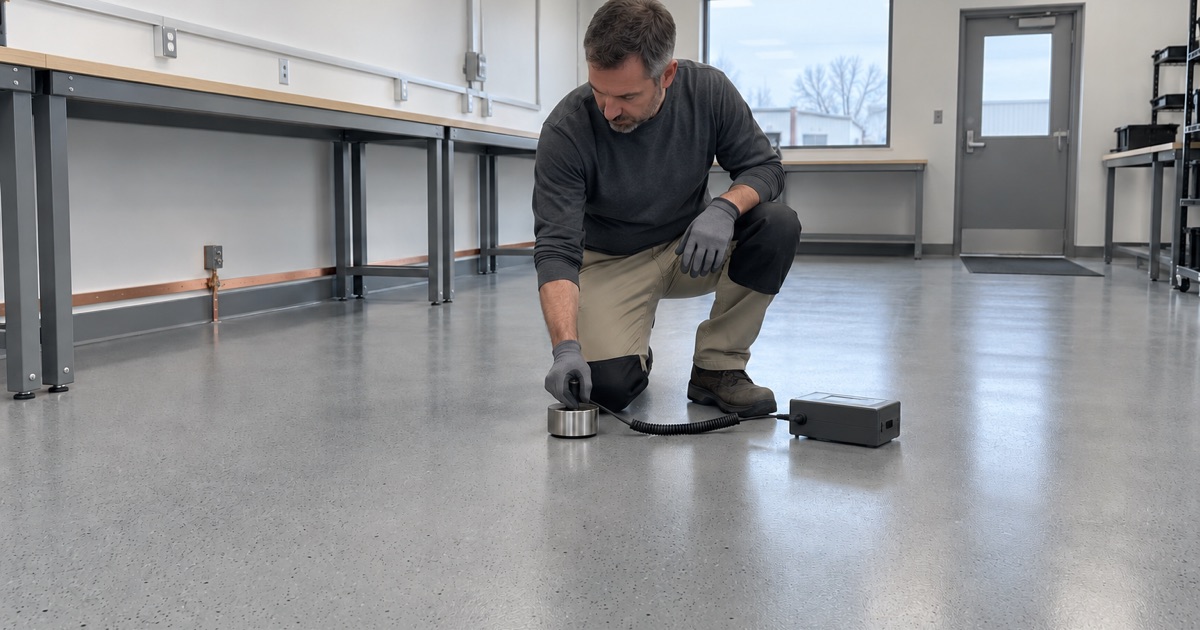
Once the floor has cured, we measure resistance across the floor surface and from the floor to ground at multiple points using a calibrated meter and electrodes designed for ESD testing. Every reading is recorded and handed over with a floor plan of where it was taken.
Those readings become your baseline. Many facilities retest periodically as part of their static control program, and comparing against the original results shows whether the floor is still performing.
Cleaning ESD Floors Correctly
The wrong cleaner can ruin an ESD floor’s performance. Waxes, many polishes and some general-purpose cleaners leave insulating films that push resistance out of range. We provide written guidance on approved cleaners and cleaning methods so your maintenance staff keep the floor working.
Scheduling Around Operations
ESD floors are often installed in working facilities. We phase the work by room or zone, use overnight and weekend windows where needed, and plan around equipment moves so sensitive areas are out of service for as short a time as possible.
- 20+ Years Coating Concrete
- Moisture Test in Every Scope
- Free Written Estimates