Waterloo Epoxy Flooring installs commercial kitchen flooring in Waterloo, IA, serving surrounding cities including Evansdale, Cedar Falls, Waverly, Independence, Oelwein. A kitchen floor faces more abuse than almost any other floor in a business: hot water, steam, grease, dropped pans, harsh cleaners and constant traffic, all while it has to stay cleanable and pass inspection. After 20+ years coating concrete, we plan kitchen floors around those demands from the first visit.
Restaurant, grocery and school kitchens in Waterloo are inspected by the Black Hawk County Health Department under contract with the Iowa Department of Inspections, Appeals and Licensing, against the FDA Food Code Iowa adopts. That code shapes what a kitchen floor needs: smooth, durable, nonabsorbent where it gets wet, and coved where the floor meets the wall.
The proposal names the product line, each layer, the finished thickness, the cove height and the slip texture, so your manager and inspector can see exactly what was installed. It also sets out a schedule built around your service hours.
What the Food Code Asks of a Kitchen Floor
Smooth, Durable and Cleanable
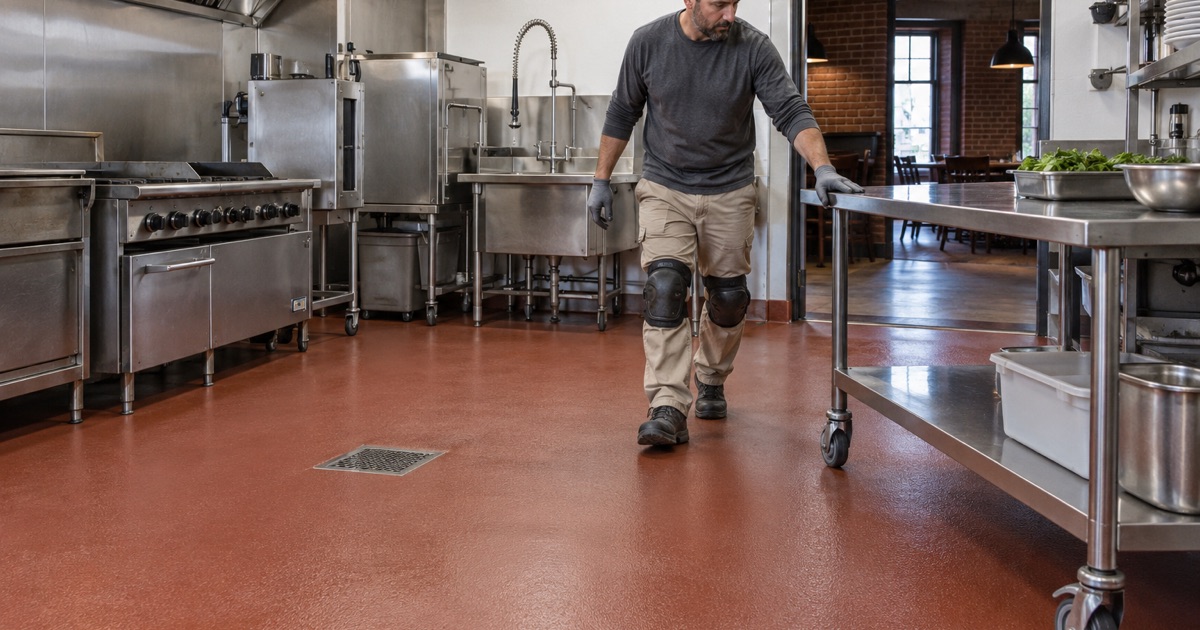
The Food Code calls for floors in food preparation and storage areas to be smooth, durable and easily cleanable, and nonabsorbent where they are exposed to moisture. Seamless resin floors meet that well because there are no grout lines to hold grease, water or bacteria.
Quarry tile has long been used in kitchens, but its grout joints wear, crack and absorb grease over time. A seamless system removes those joints entirely.
Coved Floor and Wall Junctures
In areas cleaned with water, the Food Code calls for the joint between the floor and the wall to be coved and closed, so there is no sharp corner to trap debris. We form an integral cove by running the floor system up the wall, typically several inches, in one continuous surface.
An integral cove is easier to clean than a separate vinyl or tile base, and it has no seam at the bottom for water to work behind. The cove height is listed in the proposal so it can be checked at inspection.
Slip Resistance in Wet Areas
The Food Code generally asks for smooth floors but allows a slip-resistant surface where it is needed for safety, such as dish areas, prep lines and walk-in coolers. We specify texture through the quartz aggregate broadcast and the topcoat used, matched to how the floor is cleaned.
A very coarse texture grips well but is harder to clean; a very fine one cleans easily but can be slick with grease. We balance the two for each zone of the kitchen rather than using one texture everywhere.
Systems for Commercial Kitchens
Urethane Cement
Urethane cement is our standard recommendation for commercial kitchens. It tolerates hot water, steam cleaning and the thermal shock of hot spills and cold washdown far better than standard epoxy, and it resists many fats, oils and food acids.
It is installed as a thick, troweled or slurry system with integral coves and a textured finish. It is also more tolerant of damp concrete than many epoxies, which helps on older slabs, though we still test moisture before installation.
Epoxy for Dry Storage and Front of House
Dry storage rooms, offices and some front-of-house areas see less heat and water. There, an epoxy system can be a cost-effective choice, and decorative flake or solid colors can carry the design into dining areas.
We keep the kitchen system and any decorative system separate, with a sealed transition at a doorway or a clean line, so each area gets the performance it needs. Both systems are finished at the same height, so carts roll across the transition without a lip.
Walk-In Coolers and Freezers
Cooler and freezer floors face cold temperatures, condensation and carts. These areas need a system rated for low temperatures and a texture that stays safe when wet, and freezers in particular require careful scheduling since the space must be warmed and dried before coating.
We coordinate that shutdown with your team so product can be moved to temporary storage, and we confirm the slab temperature and dew point before each coat. Bringing a freezer back down too early can damage a coating that has not finished curing, so the restart time is part of the written schedule.
Drains, Grease and Water
Floor Drains and Slope
Kitchen floors rely on floor drains and slope to move water away. We maintain or improve slope toward drains during installation and finish the system cleanly at each drain body so water does not pool at the edges.
Waterloo’s Grease Rules
Waterloo’s fat, oil and grease ordinance requires every food service establishment to capture grease before it reaches the sewer, and outdoor below-grade interceptors must be cleaned at least quarterly. Floor drains in a kitchen are among the fixtures an interceptor may serve.
During installation we protect floor drains, collect grinding dust with vacuums at the machine, and never rinse slurry or debris into drains. That keeps the work from creating problems for your grease system or the city sewer.
Preparation and Scheduling
Removing Old Tile and Coatings
Many kitchens start with worn quarry tile, failing coatings or patched concrete. We remove old flooring down to sound concrete, repair cracks and damaged areas, and grind or shot blast to the profile the system needs.
Oil-soaked concrete is common in older kitchens. Saturated areas may need degreasing or replacement so grease does not bleed back and weaken the bond.
Moisture Testing
We test kitchen slabs with ASTM F2170 relative humidity probes or ASTM F1869 calcium chloride tests before finalizing the system. Where readings exceed the manufacturer’s limit, a moisture-mitigation primer or a system tolerant of damp concrete goes into the scope.
Working Around Service
Restaurants and food businesses cannot close for long. We plan installation around your service hours, using overnight shifts, closed days and phased sections where needed, and we put the reopening schedule in writing before work begins.
- 20+ Years Coating Concrete
- Moisture Test in Every Scope
- Free Written Estimates