Epoxy Floors in Waterloo That Start With a Tested Slab

Ground concrete, a moisture test in the written scope, and a proposal that names the product, the coats and the finished thickness.

Waterloo Epoxy Flooring has spent 20+ years installing epoxy garage floors, basement floor coatings, polished concrete, polyaspartic systems and commercial and industrial floors in Waterloo, IA. Every job begins at the same place: we grind the slab, test it for moisture, and map the cracks and old coatings before anyone talks about color.

That order matters because a coating is only as good as the concrete under it. A floor that peels after one winter almost always failed at the preparation stage, not at the topcoat, so the work we do before the first coat goes down is what we put in writing and what we stand behind.

Our proposals name the product line, the number of coats and the finished thickness, so the floor in your garage, basement or plant can be checked against the quote once it cures. If a slab needs repair or replacement before it should be coated, we say so up front.

Get Your Free Quote

Fast response • No obligation

So we can reach you about your request.

So we can send you a confirmation after you submit this inquiry form.

  • 20+ Years Coating Concrete
  • Moisture Test in Every Scope
  • Free Written Estimates

What we do

Our Services

Epoxy flooring for garages, basements and commercial floors in Waterloo, IA

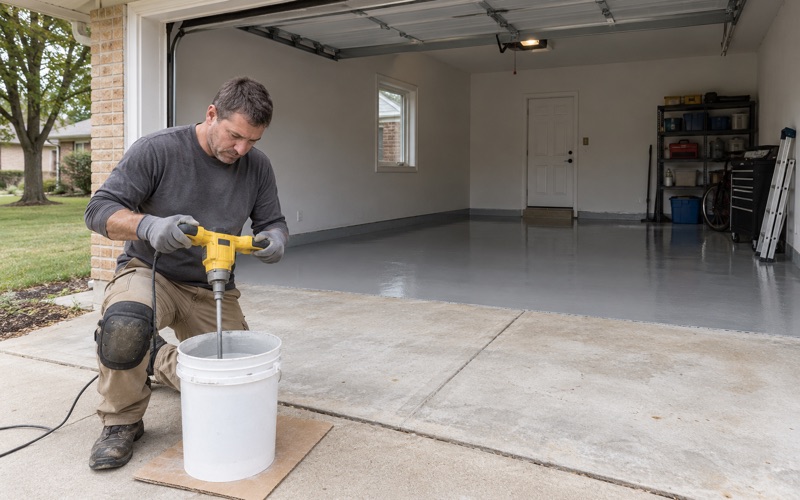
Epoxy being mixed on the apron of a Waterloo ranch house garage, the first coat already laid across the ground slab behind.

Epoxy Garage Floor

Ground, tested and built-up epoxy garage floors that stand up to Iowa road salt, hot tires and cold-season cure limits.

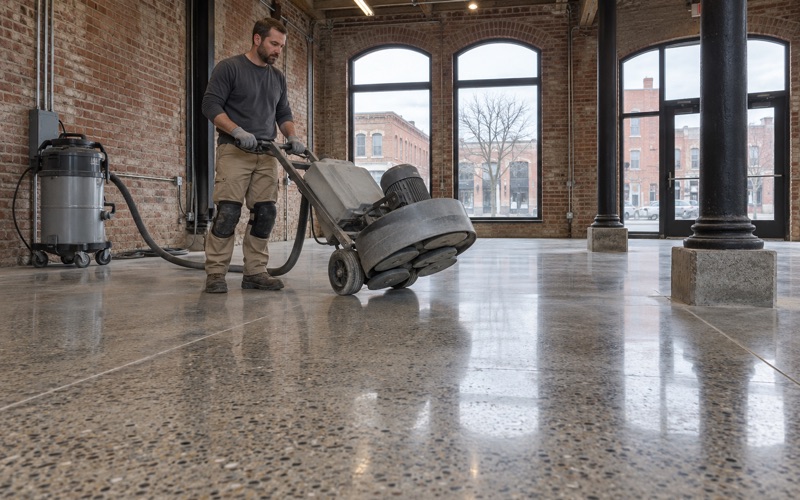
A satin polished concrete floor in an old downtown Waterloo brick building, the planetary polisher tipped back onto its wheels after the last pass.

Polished Concrete Floors

Ground, densified and polished concrete for basements, showrooms, shops and warehouses, with the aggregate exposure chosen before the first cut.

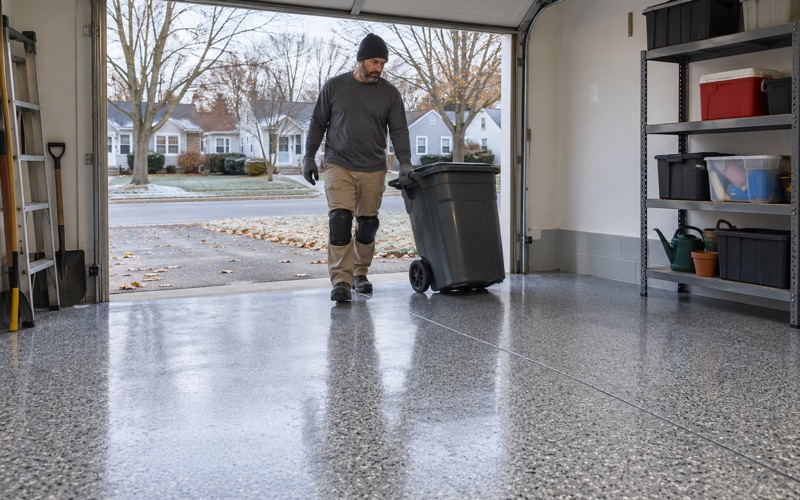
A trash cart wheeled back onto a same-day polyaspartic flake floor in a Waterloo Cape Cod garage on a cold late-autumn day.

Polyaspartic Floor Coating

Fast-curing, UV-stable polyaspartic coatings for garages, basements and commercial floors, applied over ground and moisture-tested concrete.

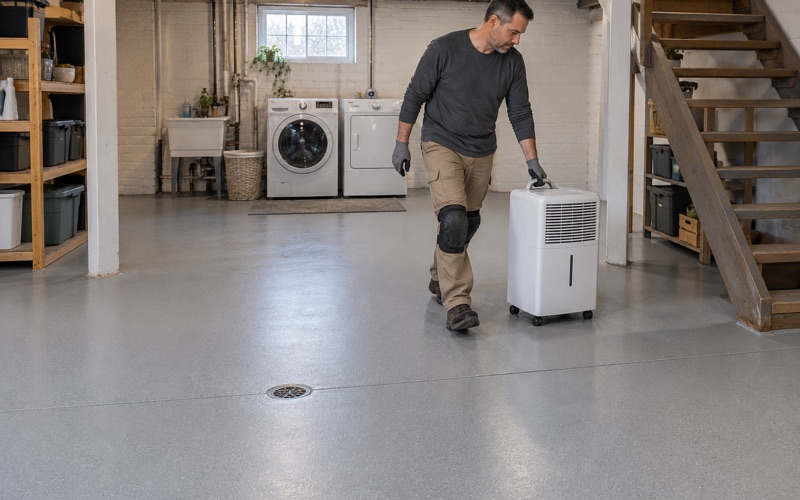
A dehumidifier rolled onto a new light gray epoxy basement floor in an older Waterloo house, the floor drain kept open in the coating.

Basement Floor Epoxy

Basement floor coatings that start with a moisture test, a look at the sump pit and drains, and a slab ground clean of old paint and glue.

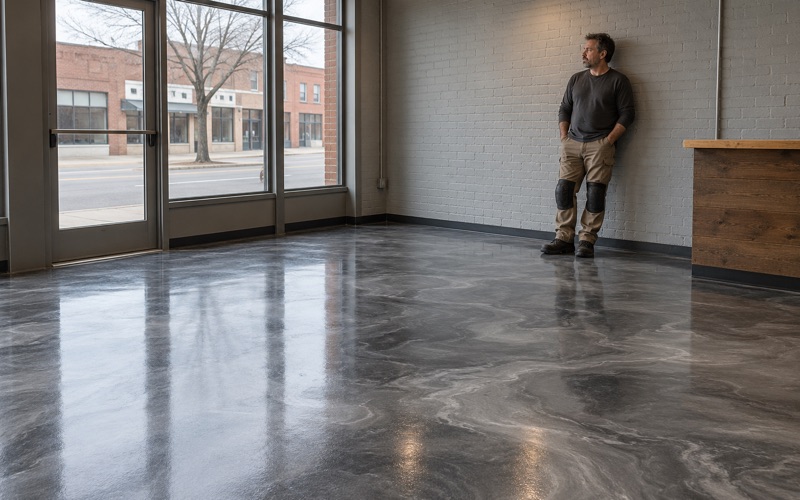
A silver and charcoal metallic epoxy floor in a Waterloo storefront, its swirled pattern catching daylight from the front windows.

Metallic Epoxy Floor

Marbled metallic epoxy floors for finished basements, garages, showrooms and offices, poured over a flat, ground and moisture-tested slab.

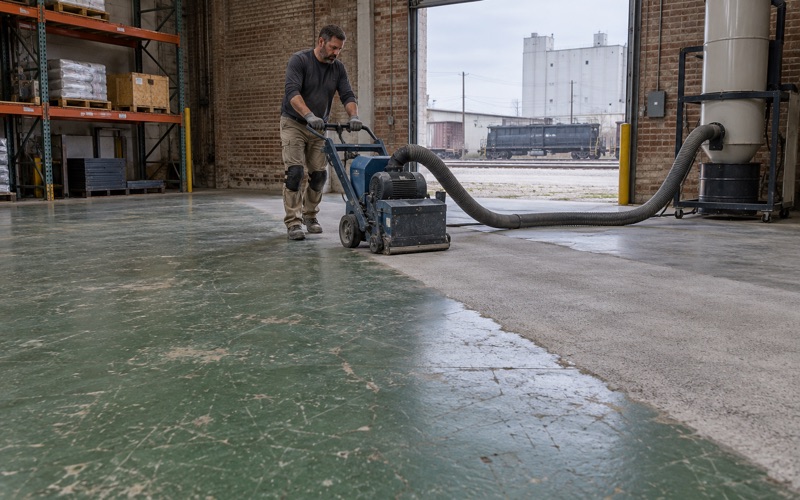
A walk-behind shot blaster opening up an old coated warehouse slab in Waterloo, the cleaned lane beside the worn coating.

Concrete Grinding

Diamond grinding and shot blasting that strip old coatings, flatten slabs and leave a measured surface profile for a new floor to grip.

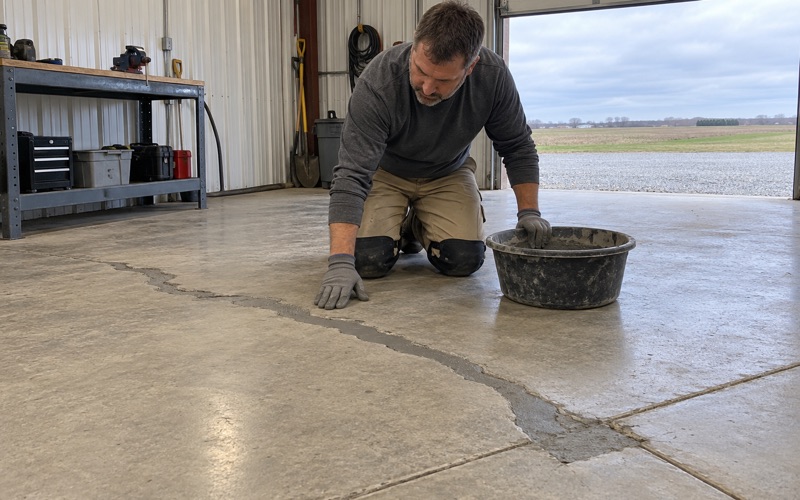
A chased-out crack and a spalled corner filled flush with repair mortar in a Waterloo shop slab, ready to grind before coating.

Concrete Floor Repair

Crack, spall, joint and scaling repairs for garage, basement and commercial slabs, with an honest call on when a slab needs replacing instead.

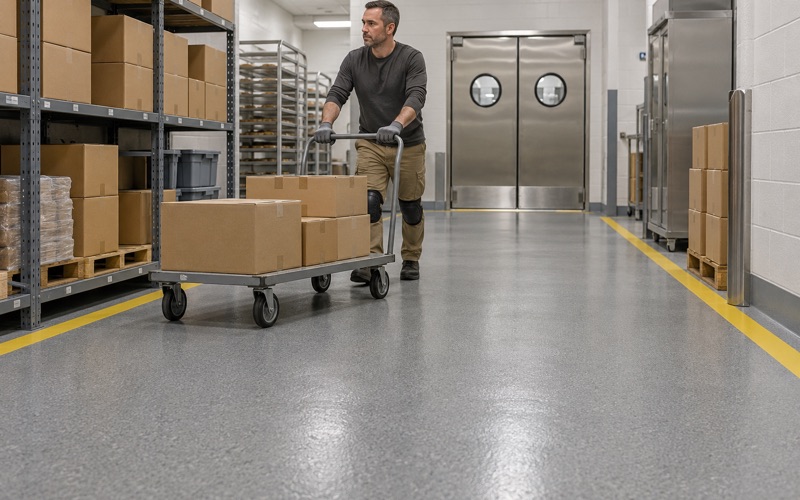
A stocking cart pushed across a new quartz-textured epoxy floor in the back room of a Waterloo grocery store.

Commercial Epoxy Flooring

Epoxy, polyaspartic and urethane floor systems for shops, retail, offices and clinics, scheduled around the hours a business has to stay open.

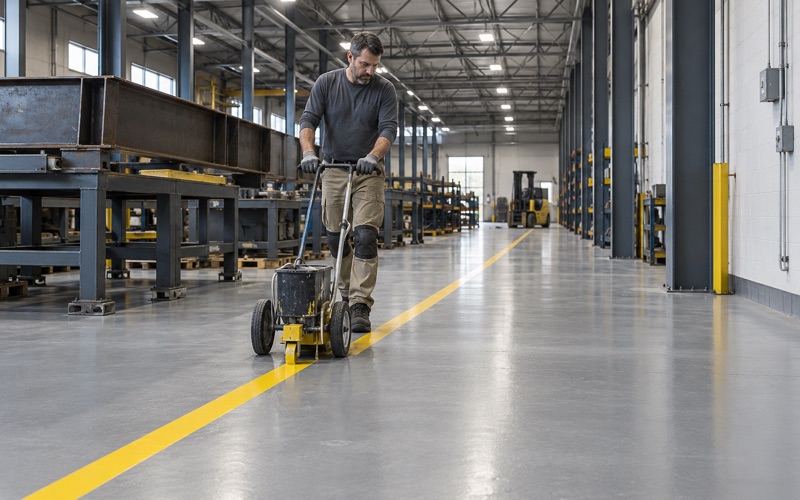
A fresh yellow aisle line being laid on a gray industrial epoxy floor in a Waterloo manufacturing plant.

Industrial Epoxy Flooring

Thick epoxy and urethane cement systems for plants, warehouses and shops, built for forklifts, chemicals and washdown and installed around shifts.

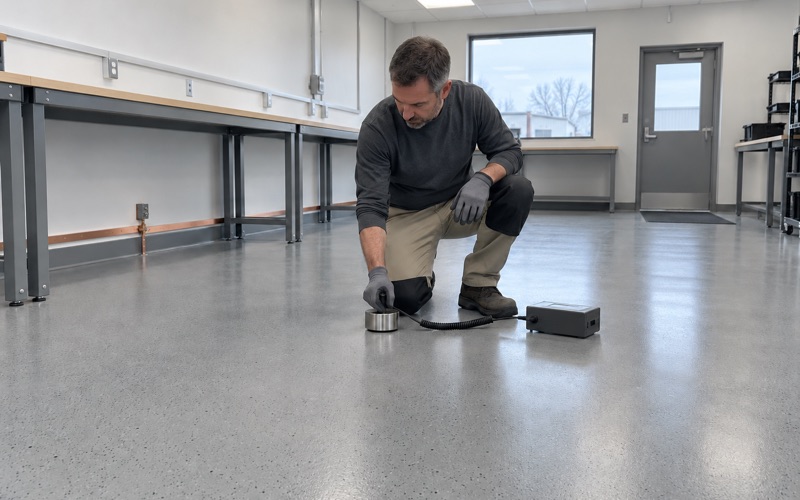
A resistance test electrode set on a new static-dissipative epoxy floor in a Waterloo electronics assembly room.

ESD Flooring

Static-dissipative and conductive epoxy floors for electronics assembly, labs, server and control rooms, grounded and resistance-tested on site.

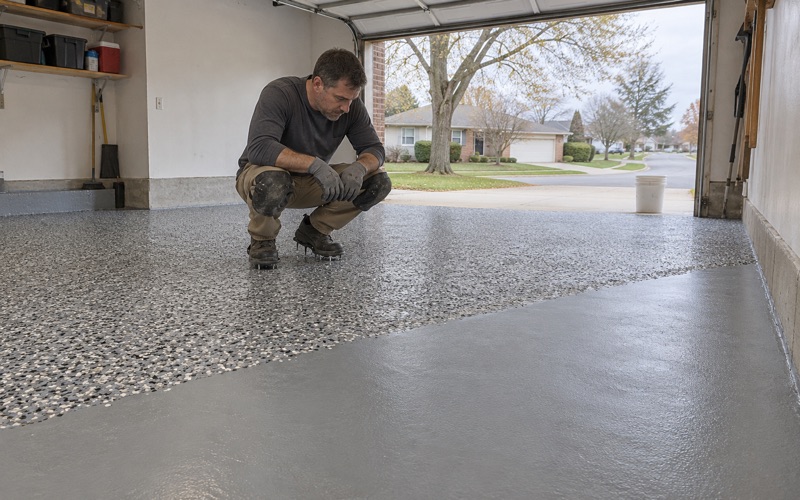
Dense gray and black flake settled on the base coat in a Waterloo garage, the worker checking coverage at the working edge.

Flake Epoxy Floor

Vinyl flake epoxy floors for garages, basements, shops and commercial spaces, with the chip blend, coverage and topcoat chosen for how the floor is used.

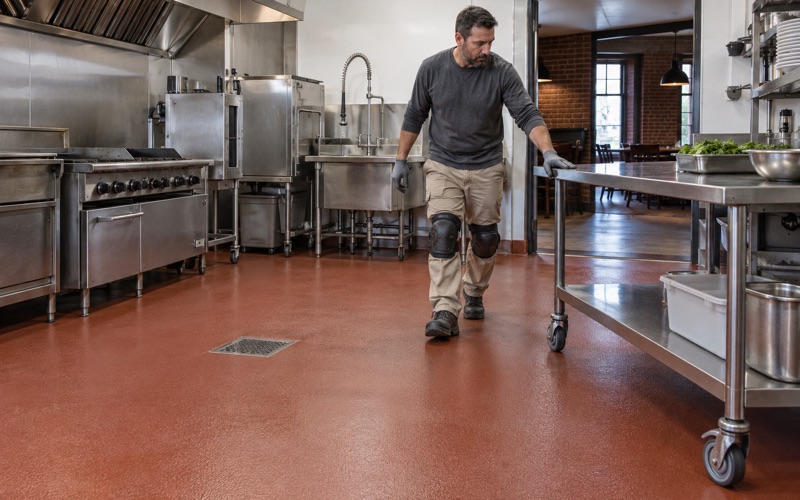
A urethane cement kitchen floor with a coved base and floor drain in a Waterloo restaurant, a prep table being rolled back into place.

Commercial Kitchen Flooring

Seamless urethane cement and epoxy kitchen floors with coved bases and wet-area texture, planned around the Food Code and installed after hours.

Built on Two Decades of Slab Work

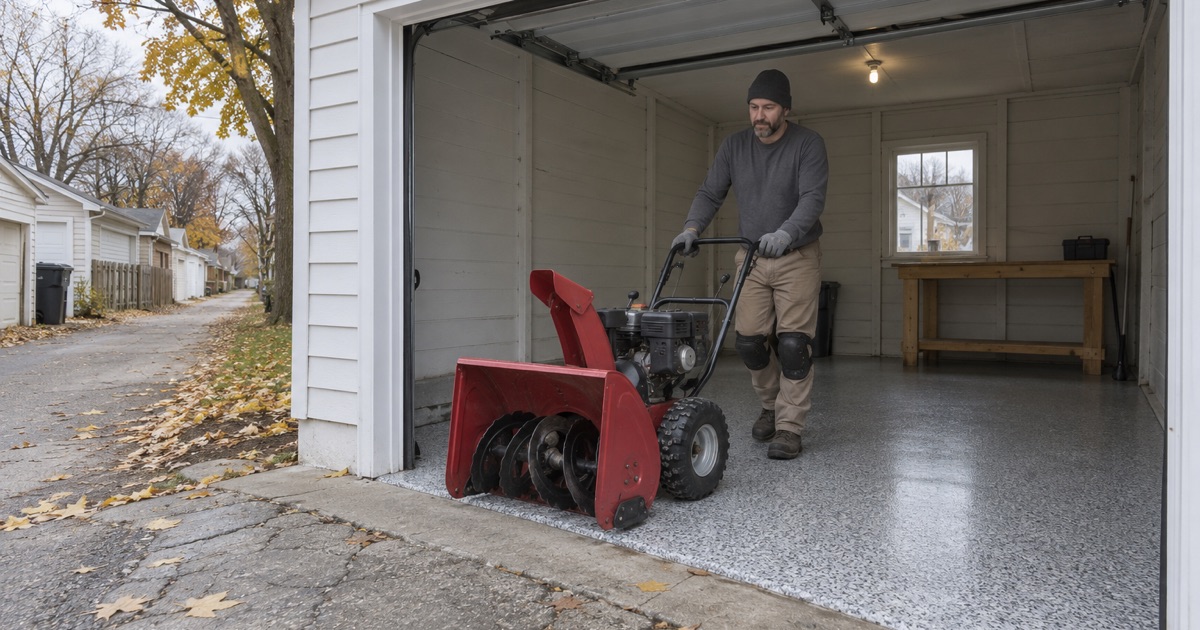
A finished gray, black and white flake floor in the detached alley garage of an older Waterloo frame house, a snowblower being wheeled back inside.

20+ Years Coating Concrete

We have been grinding, repairing and coating concrete floors for more than twenty years. That time is where our habits come from: testing before pricing, profiling instead of etching, and telling a homeowner when a slab is not ready rather than coating it and hoping.

Why Choose Waterloo Epoxy Flooring

Ground Concrete, Never Etched

Every slab we coat is opened with a diamond grinder or a shot blaster to a measured ICRI concrete surface profile, so the epoxy locks into sound concrete rather than sitting on a skin of laitance, sealer or acid residue that lets it lift.

Moisture Tested Before the Price

No garage or basement floor gets a final price until a moisture test is in the written scope, because vapor rising through a slab is what blisters a coating, and a newer house is not automatically a drier garage.

Built for Iowa Road Salt

Garage systems here are chosen for the brine and rock salt that ride in on tires from November through March, so the floor sheds deicer and wipes clean rather than pitting and scaling like a bare slab or a thin store-bought paint.

Cured to the Slab, Not the Calendar

Cure schedules follow slab temperature and dew point, and Waterloo averages more than 150 nights a year at or below 32 degrees, so an unheated garage in deep winter is told to wait instead of being coated cold and failing in spring.

Warranty Limits Named First

Before a job is sold we explain what a coating warranty leaves out, starting with moisture vapor transmission and hydrostatic pressure, so nobody learns about an exclusion after a floor fails.

Repairs Called Out Honestly

Cracks, spalls and old coatings are mapped on the first visit, and when a slab should be repaired or replaced before coating we put that in writing rather than burying a bad floor under a fresh color.

The Garage Floor, Start to Finish

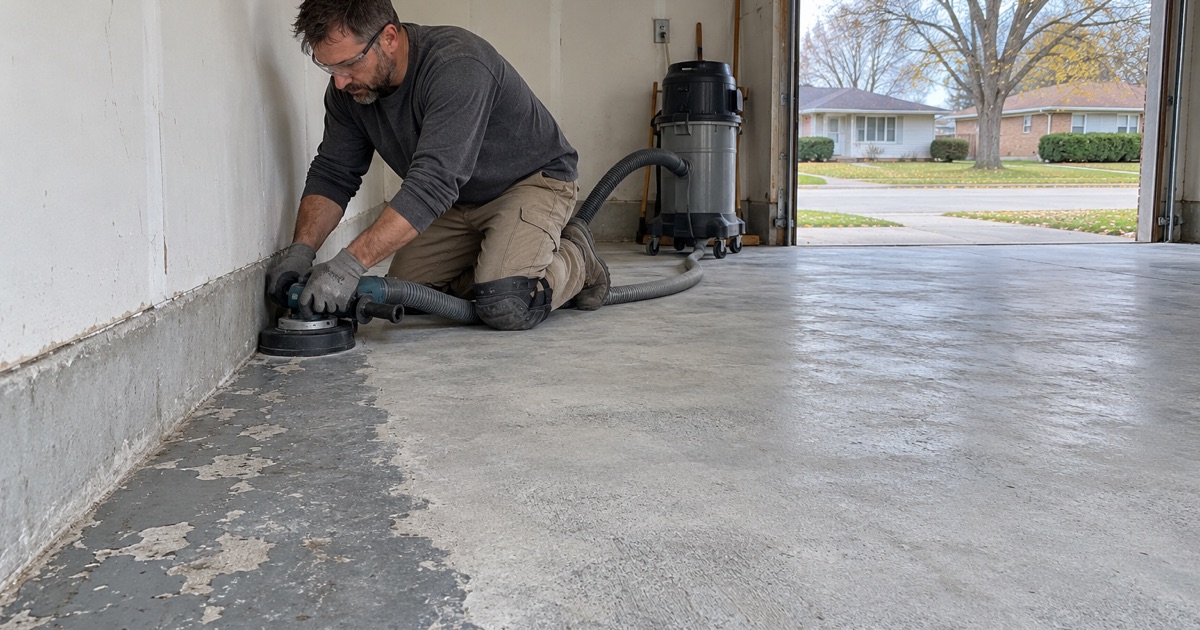
An edge grinder taking decades of old paint off the wall line of a Waterloo ranch house garage slab before any coating goes down.

How an Epoxy Garage Floor Job Runs

A typical garage job starts with a walk-through, a moisture test and a crack map, then moves to grinding, repairs, the base coat, a flake or color broadcast and a topcoat. You get the walk-on and park-on times in writing, because they change with the product line and the temperature of the slab.

Attached and Detached Garage Coatings

An attached garage shares air with the house, so we seal the door to the living space, capture grinding dust at the machine with a vacuum and offer low-odor products. A detached garage gives more freedom on product choice, but it is usually colder, which pushes the cure schedule instead.

Moisture Testing a Garage Slab

We use an ASTM F2170 in-situ relative humidity probe or an ASTM F1869 calcium chloride test, with an ASTM D4263 plastic sheet test as a quick screen. The model building code’s IRC R506.2.3 exempts garages from the under-slab vapor retarder, so many garage slabs have nothing between the concrete and wet ground.

The probe test takes longer, since the holes have to equilibrate before a reading is taken, but it measures conditions inside the slab rather than at its surface. We record the result on the proposal, so you can see the number that chose your primer and base coat instead of taking our word for it.

Why a Newer House Is Not a Drier Garage

A garage poured ten years ago can test wetter than one poured in 1955, because the vapor retarder exemption and the soil underneath matter more than the build date. That is why we test the slab whatever year the house went up.

Cracks, Spalls and When to Replace the Slab

Hairline shrinkage cracks and small spalls are routed and filled with a rigid repair material before coating. A slab that has heaved, sunk or broken into loose pieces is a replacement job, and coating it would only hide the problem for a season.

Road Salt and the Bare Garage Slab

Calcium chloride and rock salt deicers soak into bare concrete, and repeated freeze-thaw cycles then pop the surface into scaling and pitting. A properly built coating keeps the brine on top where it can be squeegeed out instead of inside the concrete.

Coating a Garage in Cold Weather

Epoxy and polyaspartic products each have a minimum slab temperature and need a safe dew point spread at the surface to cure without amine blush or a weak bond. In an unheated garage in January, the honest answer is often to book the job for spring.

Hot Tire Pickup on Cheap Coatings

A warm tire softens a thin, poorly bonded coating, and when the car cools and pulls away it can lift the coating with it. A ground slab, a 100% solids epoxy base and a polyaspartic or polyurea topcoat are what keep a floor from peeling in tire-shaped patches.

Hot tire pickup is the most common complaint we hear about floors other people coated, and it nearly always traces back to the same short list: an etched slab, a thin water-based product and no real topcoat. Fixing it means grinding the failed coating off entirely, so it costs more than doing the floor right once.

Store-Bought Kits Versus a Built-Up Floor

Most retail kits are a thin, water-based coating rolled over an acid-etched slab. A professional floor is ground, repaired and built in several coats to a stated thickness, which is the difference between a one-season finish and a floor that handles tires and salt for years.

What Moves the Price of a Garage Floor

The size of the slab matters, but so do old paint or sealer that has to come off, the number of cracks, whether the slab needs a moisture-mitigation primer, and the choice of topcoat. We itemize each of those in the proposal so the total makes sense.
Basements, Sump Pits and Damp Slabs

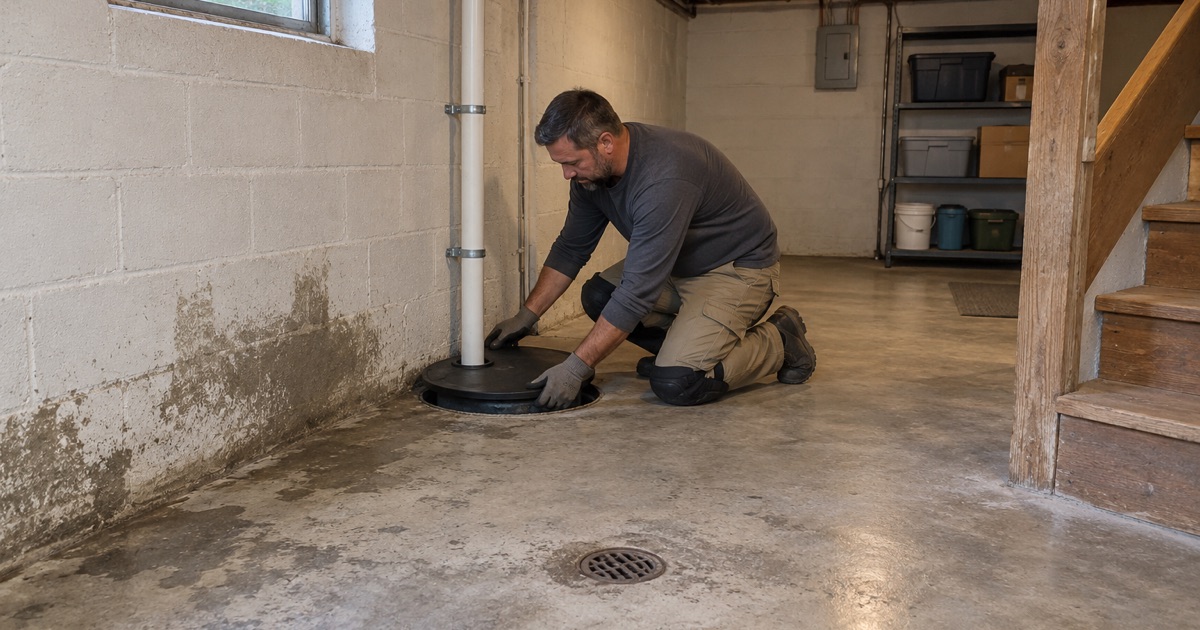
A sealed lid being seated on the sump basin in an older Waterloo basement, the floor drain and a damp patch on the bare slab nearby.

Basement Floor Epoxy and the Moisture Question

A basement slab sits in the ground, so before we talk about color we test how much vapor is moving through it. The result decides whether a standard epoxy will hold, whether the floor needs a mitigation primer first, or whether it should not be coated at all.

We would rather lose a basement job at the testing stage than install a floor that blisters by spring. When the numbers say the slab is too wet for any system we would stand behind, we tell you that, explain what is driving the moisture, and leave the decision about drainage work with you.

Sump Pits, Drain Tile and Floor Drains

We check the sump pit and the floor drain before quoting, because they tell us how water has moved under and across the floor. The coating is finished cleanly to the drain and the pit edge so it does not trap water or block the drain tile system.

Old Paint, Patching and Tile Glue

Waterloo’s housing is old, with nearly half of homes built before 1960, and many basement floors carry decades of paint, patches and black tile adhesive. Those layers come off with a grinder down to sound concrete, because a new coating bonds no better than the weakest layer under it.

Some older black tile adhesives and floor tiles can contain asbestos, so we do not grind an unknown mastic until it has been identified. When a basement floor carries old tile or glue we flag it on the first visit and price the preparation only after the material is known.

Basements Near the Cedar River

The Cedar River crested at a record 27.01 feet at Waterloo on June 11, 2008, and lower levels near the river have seen water before. A coated floor is easier to clean after a wet event, but it is not flood protection, and we say so plainly.

Efflorescence on the Basement Floor

White powder on a basement slab is efflorescence, salt left behind when moisture moves through the concrete and evaporates. It is a sign to test carefully, and it usually means a standard coating would lose its grip without a moisture-mitigation primer.

When a Moisture-Mitigation Primer Is Needed

When an ASTM F2170 or F1869 result sits above what the coating manufacturer allows, a moisture-mitigation primer can let the system go down anyway within that primer’s rated limits. The test number decides, not a guess, and the primer is written into the scope as its own line.

Coating After Water Gets In

If a basement has taken on water, the floor has to be cleaned, the source understood and the slab given time to dry, then tested again. Coating a slab that is still releasing water is how a new floor blisters within months.

Laundry Rooms, Workshops and Home Gyms

A coated basement floor handles washer spills, dropped tools and rubber gym mats far better than bare or painted concrete. We match the texture to the room, adding grip in a laundry area and keeping a smoother finish where equipment rolls.

What a Basement Coating Warranty Leaves Out

Moisture vapor transmission and hydrostatic pressure are excluded from almost every coating warranty, and a basement is where both live. We explain those exclusions before the work is sold, along with what the warranty does cover.

Not Radon Mitigation or Waterproofing

EPA lists every Iowa county in radon Zone 1, and in Iowa radon testing and mitigation require a state credential under Iowa Code chapter 136B. A floor coating is neither radon work nor waterproofing, and we never sell it as either.

Color, Flake and Finish

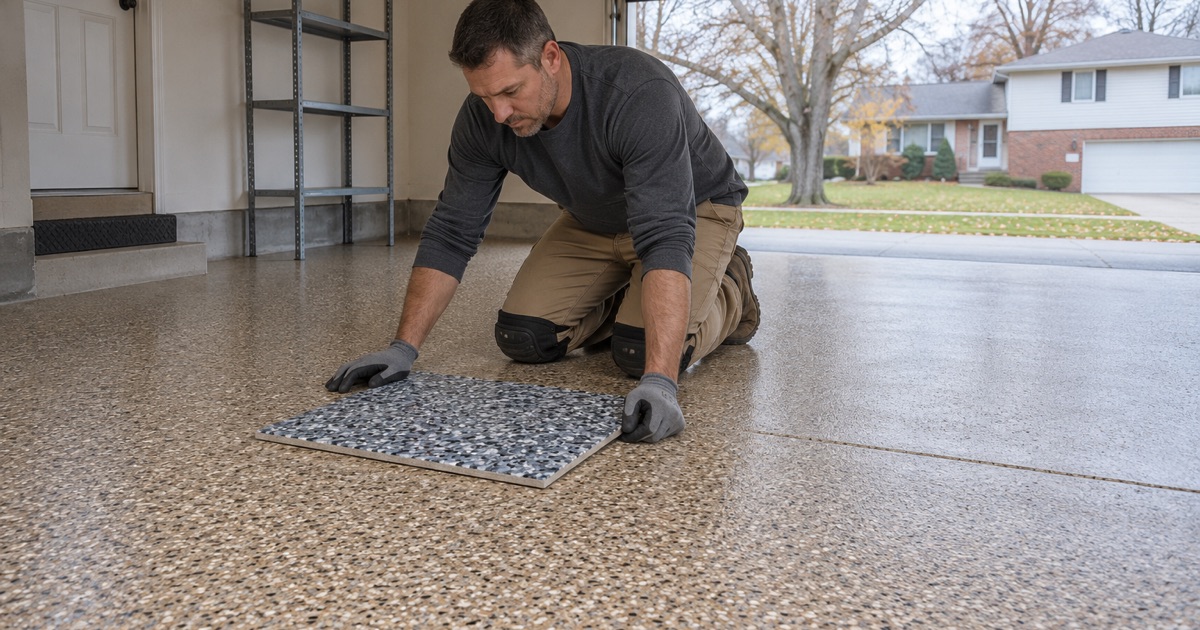
A blue-gray flake sample board laid on a finished tan and brown flake garage floor in Waterloo for a side-by-side color comparison.

Vinyl Flake Garage Floors

A vinyl flake broadcast is the most popular garage finish because it hides dust and small imperfections and adds light texture. Chip size and blend change the look: a small chip reads as a fine speckle, while a larger chip gives a bolder terrazzo-style floor.

Metallic Epoxy Floors

Metallic epoxy uses pigments that move as the coating is worked, producing a marbled, three-dimensional look. It takes a flat, well-ground slab and an installer who controls the pattern, because every pass shows in the finished floor.

Polished Concrete and Aggregate Exposure

Polished concrete is the slab itself, ground with progressively finer diamonds and hardened with a lithium silicate densifier. A light grind keeps the cream finish, while a deeper grind exposes fine or coarse aggregate, and the choice is made before the first cut.

Because polishing works the slab itself rather than covering it, old patches, stains and saw cuts stay visible in the finished floor. We walk the slab with you first and show you what will read through, so a polished floor in a showroom or basement looks the way you pictured it.

Choosing Gloss, Satin or Matte

A high gloss makes a floor look clean and bright but shows dust and tire marks faster. A satin or matte topcoat hides daily wear better, which is why many garage owners choose it for a floor that will actually be driven on.

Quartz Broadcast Floors

A quartz aggregate broadcast adds color and slip resistance in one step, which suits commercial kitchens, mudrooms and ramps. The grit level is set by the size of the quartz and how much topcoat goes over it, not left to chance.

Solid Color Floor Coatings

A single solid color is the right call for many workshops and plant floors, where a plain gray or tan makes dropped parts easy to spot. It also accepts painted safety lines and walkways cleanly.

Sunlight and Epoxy Ambering

Epoxy can yellow, or amber, under ultraviolet light from an open garage door or a south-facing window. A UV-stable polyaspartic or polyurea topcoat over the epoxy base prevents that discoloration.

Saw-Cut Lines, Borders and Logos

Existing saw-cut control joints can be honored as design lines, filled flush, or set off with a contrasting border. Shops and showrooms sometimes add a logo, which is laid out and masked before the topcoat seals it in.

Plants, Shops and Commercial Floors

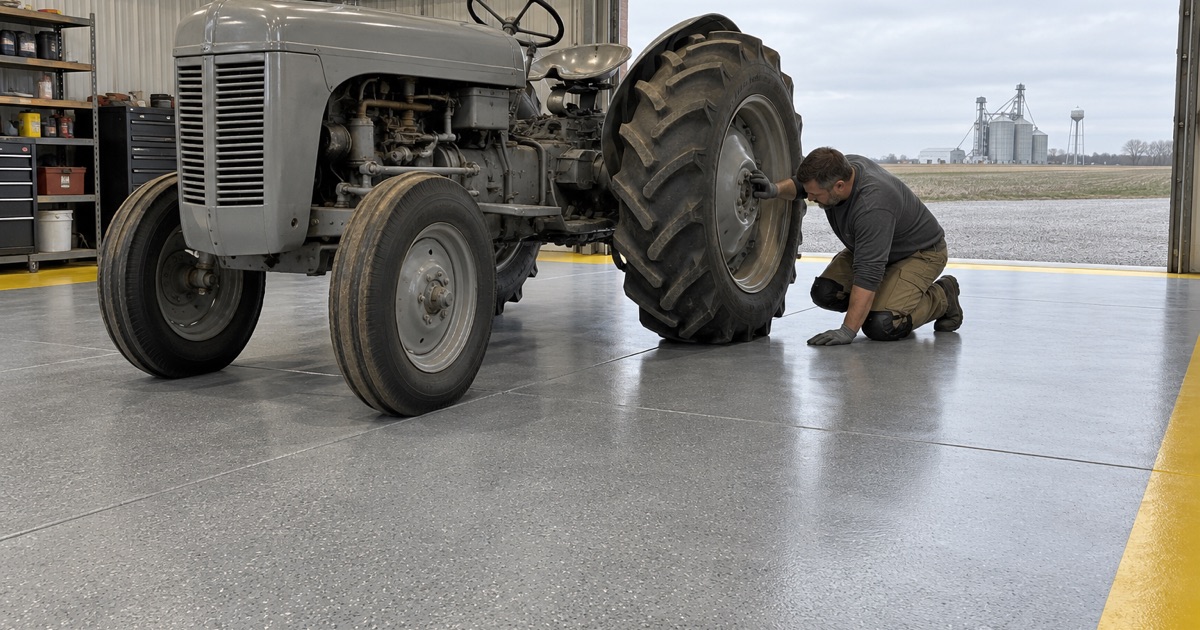
A coated gray floor in a Waterloo farm equipment repair shop, a tractor parked on it in for service.

How Commercial Flooring Jobs Differ

A commercial floor is planned around the business, not just the slab: chemical exposure, traffic, cleaning methods and the hours the space can be closed. We write the scope around those conditions and confirm the shutdown window before work begins.

Manufacturing Floor Coatings

Waterloo’s tractor, engine and foundry plants show the kind of punishment a manufacturing floor takes, with oil, coolant, hydraulic fluid and dropped parts every shift. For floors like that we choose a thicker build and a chemical-resistant topcoat sized to the actual exposure.

We ask for the safety data sheets on the fluids that actually reach the floor, then match them against the coating manufacturer’s chemical resistance chart. None of those plants is a customer of ours; they simply show what a manufacturing floor in this city is up against.

Food Plant Washdown Floors

Food plant floors are washed down every shift, often with hot water and strong cleaners. Those conditions call for a seamless, coved system that will not soften, delaminate or harbor bacteria in cracks.

Urethane Cement Systems

Urethane cement handles thermal shock from hot water, steam cleaning and spills that would soften a standard epoxy. It is the system we recommend for food processing and commercial kitchen floors where heat and washdown are daily.

Warehouse and Forklift Floors

Warehouse floors carry forklifts and pallet jacks, so the coating needs impact resistance and joints that are filled to protect the slab edges. We also stripe aisles and staging areas as part of the floor system.

Farm Shops and Equipment Dealer Bays

Farm shops and equipment dealer service bays see heavy machinery, grease and mud tracked in from fields. A thick, textured coating makes those floors easier to scrape and wash and keeps them from soaking up fluids.

Restaurant Kitchens and Grease Rules

The Black Hawk County Health Department inspects Waterloo restaurant kitchens against the 2017 FDA Food Code, which asks for smooth, cleanable floors with coved bases at the wall. Waterloo’s fat, oil and grease ordinance also requires grease capture before the sewer, so we finish the coating cleanly at floor drains and keep repair work from interfering with that system.

Wet kitchen areas also need grip, and the Food Code allows an antislip floor where it is needed for safety. We specify that texture by the quartz broadcast and topcoat used, and run the coating up the wall as a coved base so there is no seam for grease and water to settle into.

Auto Repair and Fleet Garage Floors

Auto repair and fleet garages need floors that stand up to brake fluid, solvents and rolling jacks. A chemical-resistant topcoat and a light texture keep the floor safe and easy to clean.

Office, Clinic and Showroom Floors

Offices, clinics and showrooms need floors that look finished from day one. Metallic epoxy, polished concrete or a clean solid color gives a durable surface that still reads as a deliberate design choice.

Federal VOC Limits and Low-Odor Products

Iowa has no state VOC rule for floor coatings; the federal 40 CFR 59 Subpart D limit binds the manufacturers instead. Low-odor products are still worth asking for in an occupied building, and we offer them as a comfort choice rather than a legal one.

Night and Weekend Floor Installations

When a business cannot close, we phase the floor in sections and work overnight or on weekends. Fast-curing products can return a section to service quickly, and the schedule is confirmed in writing before we start.

Areas We Serve

Waterloo Epoxy Flooring provides epoxy-flooring throughout the greater Waterloo area, with the same crews and the same standards on every job.

Good to know

Frequently Asked Questions

How much does an epoxy floor cost in Waterloo?

We price every floor after we have seen and tested it, because the slab decides the cost more than the square footage does. Grinding off old paint, filling cracks, adding a moisture-mitigation primer or choosing a polyaspartic topcoat each move the number, and the written proposal itemizes them so you can see where the money goes.

How long does a garage floor coating take from start to finish?

Most two-car garages are ground, repaired and coated over one to two working days, followed by a cure period before you drive on it. The cure time depends on the product line and the slab temperature, so we give you the walk-on and park-on times in writing for your specific floor rather than a generic promise.

Do you hold a contractor license for this work?

Waterloo licenses builders, remodelers and roofers, and its permit page lists painting, tiling and similar finish work among the jobs that do not need a permit. We make no license claim on this site for coating work. Iowa also runs contractor registration under Iowa Code chapter 91C, and asking any flooring contractor for their registration is a reasonable first question.

What is the difference between epoxy and polyaspartic coatings?

A 100% solids epoxy builds thickness and bonds hard to ground concrete, but it cures slowly and can amber under sunlight. A polyaspartic topcoat cures much faster, resists ultraviolet light and holds up well to hot tires, so many of our garage systems pair an epoxy base with a polyaspartic top.

Can you coat a floor in the winter?

In a heated basement or shop, yes. In an unheated garage we watch the slab temperature and the dew point spread at the surface, and when the concrete is too cold for the product to cure properly we tell you to wait for warmer weather instead of coating it anyway.

Will an epoxy coating stop water coming into my basement?

No. A floor coating is not waterproofing, and it does not stop seepage or hydrostatic pressure from below. We check the sump pit, the floor drain and the slab for signs of past water first, and a moisture test tells us whether the floor can be coated at all.

What does a coating warranty usually exclude?

Almost every manufacturer and installer warranty excludes failures caused by moisture vapor transmission and hydrostatic pressure, which is why we name those exclusions before the job is sold. Damage from chemicals outside the product's resistance and from gouging under heavy equipment is also commonly left out.

Is the coating smell a problem in an attached garage or basement?

Some products carry a noticeable odor while they cure. We offer low-odor options for attached garages and basements as a comfort and re-entry choice, and we explain that Iowa has no state rule requiring them; the federal VOC limit binds the manufacturers instead.

Do you prepare the concrete with acid etching?

No. We open every slab with a diamond grinder or a shot blaster to a measured concrete surface profile, because acid etching leaves an inconsistent surface and residue that can weaken the bond. Grinding dust is captured at the machine by a vacuum rather than washed toward a drain.

Do you work on commercial and industrial floors?

Yes. We coat restaurant kitchens, shops, warehouses, plant floors and showrooms, and we schedule the work in phases around shifts, with overnight and weekend windows when a line or a dining room cannot shut down.

Ready to Get Started?

Request a free quote today and we'll get back to you fast.