
Waterloo Epoxy Flooring grinds and polishes concrete floors in Waterloo, IA, serving surrounding cities including Evansdale, Cedar Falls, Waverly, Independence, Oelwein. After 20+ years working concrete, we have learned that a polished floor is only as good as the slab it is cut from, so we assess that slab carefully before promising a finish.
Polished concrete is not a coating. We grind the existing floor with a sequence of progressively finer diamonds, harden it with a lithium silicate densifier, and hone it to the sheen you choose. Nothing sits on top to peel, which is why polished floors are popular in warehouses, stores and showrooms, and increasingly in basements and finished garages.
Because the slab itself becomes the finish, old patches, cracks and saw cuts become part of the look. We walk the floor with you, map what will show through, and write the grind depth, the densifier and the final sheen into the proposal so the result can be checked against what was agreed.
How We Polish a Concrete Floor
Assessing the Slab First
The first visit is about the concrete, not the shine. We look for cracks, spalls, previous patches, old coatings and adhesive, and how hard the surface is. Some floors have a thin, weak top layer, others have aggregate close to the surface, and each changes how the grind will go.
On larger jobs or uncertain slabs we grind a small test area. It shows how the concrete responds and what the aggregate looks like underneath, so nobody commits to a finish based on a guess about what is under the surface.
Grinding Through the Diamond Sequence
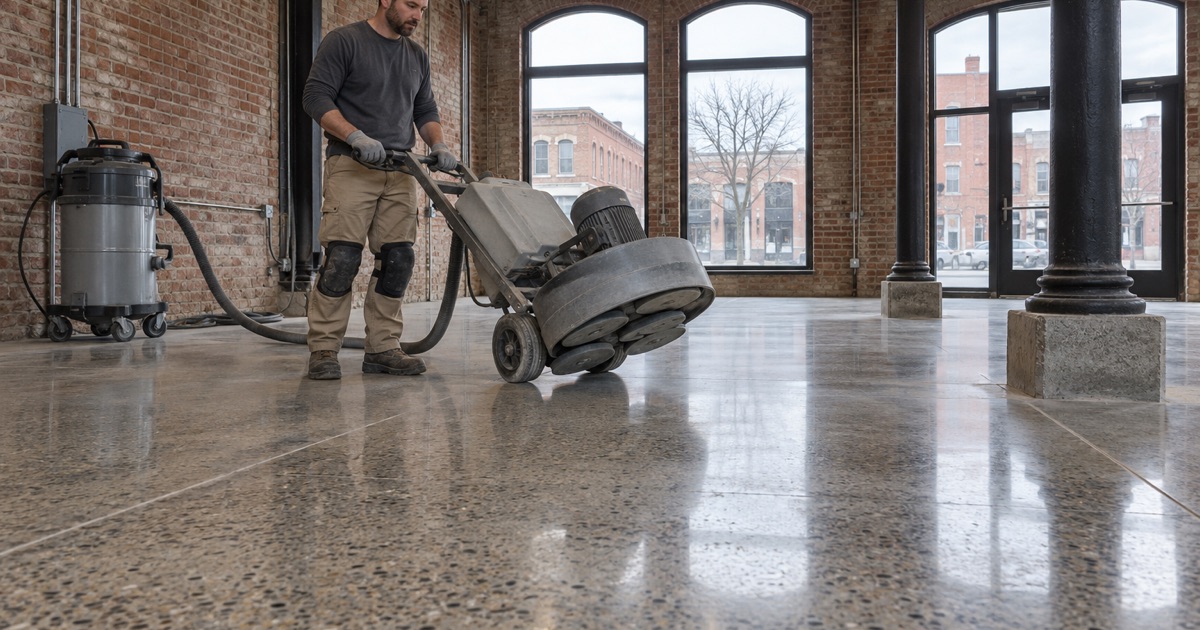
Grinding starts with coarse metal-bond diamonds to flatten the floor and remove coatings and surface defects. We then step through finer metal and resin-bond diamonds, each pass removing the scratches of the one before, and every pass runs with dust captured at the machine by a vacuum.
Skipping steps in that sequence is the most common shortcut in polishing. It leaves swirl marks and a hazy finish that no amount of burnishing will fix, so the full sequence is written into our scope.
Densifying and Honing
Partway through the grind we apply a lithium silicate densifier, which reacts with the concrete to harden the surface and reduce dusting. Honing then continues to the selected sheen, from a low satin to a high-gloss polish, and an optional guard adds stain resistance on top.
Densifying is what turns a sanded slab into a durable floor. Without it, a polished surface can wear and dust quickly in high-traffic areas.
A guard applied at the end is a thin, penetrating treatment rather than a film coating. It improves resistance to everyday spills and makes the floor easier to clean, and it can be renewed during routine maintenance without grinding the floor again.
Aggregate Exposure and Finish Choices
Cream, Salt and Pepper or Full Aggregate
How deep we grind decides what you see. A cream finish stays at the surface paste with almost no stone showing. A salt-and-pepper finish exposes fine sand and small aggregate, and a full aggregate exposure cuts deeper to show larger stones across the floor.
The choice has to be made before the first cut, since you cannot put concrete back once it is ground away. We show examples and, where possible, a test patch on your own slab, because two floors poured in different decades rarely look the same at the same depth.
Aggregate is rarely spread evenly through a slab, either. Floors that were troweled hard or poured with a heavy cream layer can show stone in one area and plain paste a few feet away, and a test patch is the honest way to find that out before the whole floor is committed to one depth.
Picking a Sheen Level
Sheen ranges from a matte hone to a high-gloss polish. Higher gloss reflects more light and looks striking in showrooms, while a lower sheen hides scratches, footprints and dust better in a working shop or a busy household.
Sheen is set by how far up the diamond sequence we go and by the guard applied at the end. Because it is a property of the surface rather than a coating, a floor that loses gloss in a traffic lane can be burnished back up without redoing the whole floor, which is one of the practical advantages of polishing over a film finish.
Patches, Cracks and Saw Cuts
Cracks and old patches will show in a polished floor, since there is no coating to cover them. We can fill cracks with a color-matched filler and honor saw-cut control joints as design lines, but we are honest that a polished slab shows its history.
For some floors that character is the appeal. For others, a heavily patched or stained slab is better served by a coating, and we will say so rather than polish a floor you will not like.
Residential Polished Concrete Floors
Basements and Lower Levels
A polished basement floor is easy to clean, durable and does not trap moisture under a film the way some coatings can. Before polishing, we still check the slab for signs of past water, the sump pit and the floor drain, since polishing does nothing to stop seepage.
Waterloo’s older homes often have basement floors with paint, tile adhesive and patches. Those come off during the coarse grind, though some old adhesives need to be identified before grinding, and the patches that remain will show in the finished floor.
Garages and Workshops
Polished concrete can work in a garage or workshop, though it is less forgiving of road salt and oil than a coated floor. We discuss how the space is used before recommending it, and in a garage that sees heavy winter traffic we may suggest a coating instead.
The reason is chemistry as much as wear. Calcium chloride and rock salt brine can etch and stain a polished surface over a few winters, and motor oil soaks in faster than it would on a sealed coating. In a heated workshop or a hobby space where the car rarely parks, those concerns shrink, and a polished floor can be a durable, low-maintenance choice.
Commercial Polished Concrete Floors
Retail, Showroom and Office Floors
Stores, showrooms and offices choose polished concrete for its clean look and low maintenance. A high-sheen finish brightens a space, and regular auto-scrubbing keeps it looking good without the stripping and waxing cycle of vinyl tile.
We phase commercial work around business hours, often working overnight or on weekends. Because polishing needs no long cure, a section can be back in service soon after we finish it.
Warehouses and Distribution Floors
Large warehouse slabs benefit from densifying and polishing, which harden the surface, reduce concrete dust that settles on stock, and improve light reflection. Filling joints protects their edges from forklift wheels, a common source of damage on busy floors.
On an occupied warehouse we work in zones, moving racking and stock with your team and grinding one section while the rest of the building keeps shipping. Dust control matters even more here, since product sitting on open shelving should not come away gray, so every grinder runs connected to an industrial vacuum.
Polishing a warehouse floor also brightens it. A densified, honed slab reflects more of the existing overhead light than raw concrete, which many operators notice in aisles that used to feel dim.
Maintaining a Commercial Polished Floor
A polished floor stays at its best with a pH-neutral cleaner and periodic burnishing. Harsh or acidic cleaners can dull it, so we leave the maintenance team with clear guidance on products and schedules suited to the traffic the floor will see.
Most wear shows first at entrances, where grit tracked in from parking lots acts like sandpaper on the surface. Good walk-off mats inside each door do more to protect the sheen than any product, and we point out where they belong when we hand the floor over.
- 20+ Years Coating Concrete
- Moisture Test in Every Scope
- Free Written Estimates